• Skip to primary navigation
  • Skip to main content
  • Skip to primary sidebar
Kenya Information Guide

FamousKenya

Kenya Information Guide

  • Home
  • About Kenya
    • Tribes
  • Famous People
  • Travel
    • Tourist Attractions in Kenya
    • Towns
    • Hotels
  • Contact Us

Rabai Museum

February 4, 2025 by

A Guide To Rabai Museum

Rabai Museum is well known in the annals of history as the place where Christianity and modern learning in Kenya started well over 150 years ago.  In 1994 the Krapf Memorial Museum was founded to give formal and a perpetual reminder to monumental events during the advent of early missionaries. Stories about the first missionaries were passed on by word of mouth and are still told today. [Read more…] about Rabai Museum

Kitale Museum

February 4, 2025 by

A Guide To Kitale Museum

Kitale Museum was the first of the Inland museums to be developed in Kenya. It used to be known by the name the Stoneham Museum. It got its name from an amateur naturalist who lived in Kitale, by the name Lieutenant colonel Hugh Stoneham. He had a collection of insects, other animals and books from 1894 when he was only five years old. He continued his collection until 1966 when he died. Mrs. Linda Donley a peace Corp volunteer was the first curator in 1974. [Read more…] about Kitale Museum

Desert Museum

February 4, 2025 by

A Guide To Desert Museum

Located on top of a hill, with a backdrop of the picturesque Lake Turkana, also known as the “Jade Sea”, the Desert Museum, Loiyangalani was opened in June 2008. [Read more…] about Desert Museum

Lake Naivasha

February 4, 2025 by

Just half-way before Lake Nakuru and about an hour’ s drive from Nairobi, is Lake Naivasha, the “Sunshine Lake”, lying at about 1890 meters above sea level. It is a strangely fresh water lake on the floor of the Rift Valley with no outlet, but believed to have an underground seepage flow.

Lake Naivasha Travel Guide

Lake Naivasha is a beautiful freshwater lake, fringed by thick papyrus. The lake is almost 13kms across, but its waters are shallow with an average depth of five metres. Lake area varies greatly according to rainfall, with an average range between 114 and 991 sq kms. At the beginning of the 20th Century, Naivasha completely dried up and effectively disappeared. The resulting open land was farmed, until heavy rains a few years later caused the lake to return to existence, swallowing up the newly established estates.

Afternoon wind and storms can cause Lake Naivasha to become suddenly rough and produce high waves. For this reason, the local Maasai christened the lake Nai’posha meaning ”rough water”, which the British later misspelt as Naivasha..

Lake Naivasha and its surrounds are rich in natural bounty, and the fertile soils and water supply have made this one of Kenya’s prime agricultural regions.

Much of the lake is surrounded by forests of the yellow barked Acacia Xanthophlea, known as the yellow fever tree. These forests abound with bird life, and Naivasha is known as a world class birding destination.

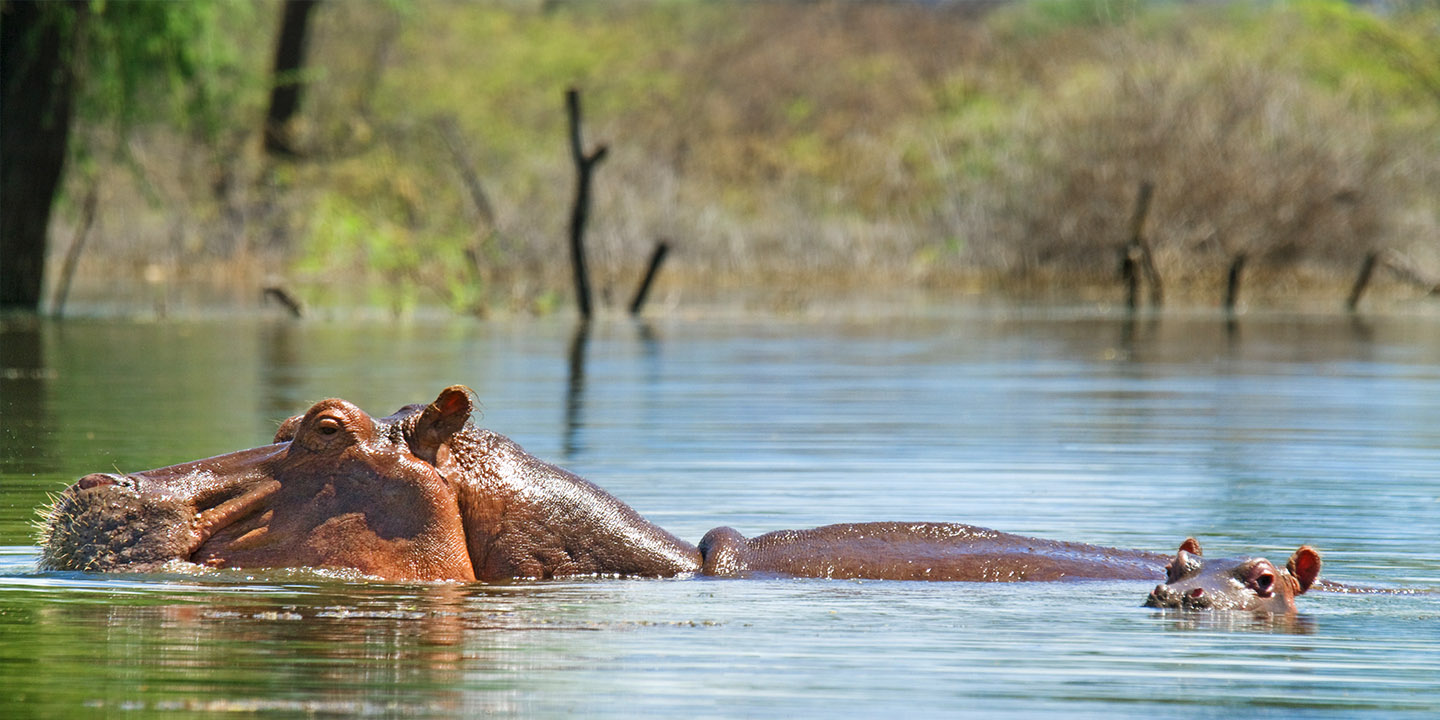
The waters of Lake Naivasha draw a great range of game to these shores. Giraffes wander among the acacia, Buffalo wallow in the swamps and Colobus monkeys call from the treetops while the Lakes large hippo population sleep the day out in the shallows.

The region surrounding Lake Naivasha is well worth exploring. There are two more smaller lakes nearby, Oloidien, and Sonachi, a bright green cater lake.

Hell’s Gate National Park lies beside the lake. This Park was named for its pair of massive red tinged cliffs framing a geothermically active interior of steam vents and bubbling springs. The park is home to a profusion of plains game and birdlife. Walking is permitted, making it ideal for hiking, biking, and rock climbing.

Boat trips on the lake are widely available, and is a great way to spend an afternoon or morning.

Sunsets are always stunning, with the haunting call of a Fish Eagle high over Lake Naivasha bringing the day to a perfect end….

About Lake Naivasha

Lake Naivasha is at the highest elevation of the Kenyan Rift valley at 1,884 metres (6,181 ft) in a complex geological combination of volcanic rocks and sedimentary deposits from a larger Pleistocene era lake. Apart from transient streams, the lake is fed by the perennial Malewa and Gilgil rivers. There is no visible outlet, but since the lake water is relatively fresh it is assumed to have an underground outflow.

Lake Naivasha has a surface area of 139 km², and is surrounded by a swamp which covers an area of 64 square km, but this can vary largely depending on rainfall. It is situated at an altitude of 1,884 metres (6,180 ft). Lake Naivasha has an average depth of 6 m (20 ft), with the deepest area being at Crescent Island, at a maximum depth of 30 m (100 ft). Njorowa Gorge used to form the lake’s outlet, but it is now high above the lake and forms the entrance to Hell’s Gate National Park. The town of Naivasha (formerly East Nakuru) lies on the north-east edge of the lake.

History of Lake Naivasha

The Germany naturalist Gustav Fischer was the first white man to see Lake Naivasha on 11th may, 1883, before he and his 300 strong caravan was chased back to the Coast by the Maasai. Since then, the lake has been described as a “bewilderment of birds” due to its amazing variety of both aquatic and terrestrial birdlife where more than 340 bird species can be spotted in a single visit. The lake water level fluctuates with the rainfall and has fluctuated that way for many years.

Lake Naivasha views are dominated by the shadow of Mt. Longonot 2,777 meters (9,109 ft.) a partly extinct volcano which has been declared a national park (52 Sq.Kms.) and whose fantastic views can be obtained from the eastern escarpment on the scenic highway to the region.

The Naivasha yellow-barked and umbrella thorn trees were once called “yellow fever trees” after the explorers who camped under them caught malaria fever from the bites of the mosquitoes, which the trees’ dampy shades harboured . After a period of wanton destruction by charcoal burners in the early 1970s, the trees are now strictly protected and form the major flora attraction around Lake Naivasha shores and its environs.

Between 1937 and 1950, Lake Naivasha was used as a landing place for flying boats on the Imperial Airways passenger and mail route from Southampton in Britain to South Africa. It linked Kisumu and Nairobi. Joy Adamson, the author of Born Free, lived on the shores of the lake in the mid-1960s.

On the shores of Lake Naivasha is Oserian (“Djinn Palace”), which gained notoriety in the Happy Valley days between the two world wars. It now forms part of the Oserian flower farm. In 1999, the Lake Naivasha Riparian Association received the Ramsar Wetland Conservation Award for its conservation efforts regarding the Lake Naivasha Ramsar site.

Lake Naivasha
Lake Naivasha

What to see in Lake Naivasha

Lake Naivasha is home to a variety of types of wildlife including over 400 different species of bird and a sizeable population of hippos. The fish community in the lake has been highly variable over time, influenced by changes in climate, fishing effort and the introduction of invasive species. The most recent shift in the fish population followed the accidental introduction of common carp in 2001. Nine years later, in 2010, common carp accounted for over 90% of the mass of fish caught in the lake.

There are two smaller lakes in the vicinity of Lake Naivasaha: Lake Oloiden and Lake Sonachi (a green crater lake). The Crater Lake Game Sanctuary lies nearby, while the lake shore is known for its population of European immigrants and settlers.

Lake Naivasha: A Recreational Area

Due to its closeness to Nairobi, Lake Naivasha has become an important recreational area for city dwellers who go there for adventure trekking, game watching trips, sailing, water-skiing and fishing activities organized for the recreation of the visitors.

Between Lake Naivasha and Mt. Longonot stands the Hells Gate with rock climbs and a sky-throbbing Fischer’s Tower. The area has also been declared a national park (68 Sq. Kms), for the protection of the rarest of Kenya’s vulture population the Lammergeyer which nests on the rock cliffs. Other wildlife species – buffalo, zebra, eland, kongoni, gazelles, impala and birds abound in the park.

If you can spare thirty minutes visit the Olkaria Geothermal Power Station built in 1982 on the periphery of the National Park where about fourteen wells have been drilled in the volcanically active Olkaria Ridges to tap gaseous steam from underground. The steam drives turbines to produce electricity.

The station produces 40 megawatts or 16% of all electricity produced in the country; thus making kenya one of the 18 countries in the world to utilize geothermal energy.

How to get to Lake Naivasha

Main road access to Lake Naivasha is directly from Nairobi by bus/Matatu or private transport. The main highway continues from Naivasha to Nakuru. Naivasha is just over an hour from Nairobi. There is an airstrip in Naivasha, with charter flights available. Some lodges and guesthouses here have private airstrips. Many hotels and lodges here can organise transfers from Nairobi to Naivasha.

Lake Naivasha Hotels

  1. Great Rift Valley Lodge & Golf Resort
  2. Lake Naivasha Country Club-Sun Africa Hotels
  3. Enashipai Resort & Spa
  4. Lake Naivasha Villas
  5. Jacaranda Lake Elementaita Lodge
  6. Sarova Lion Hill Game Lodge
  7. The Ark
  8. Eastmark Hotel

Things to do Around Lake Naivasha

Take a boat safari

The most popular attraction at Lake Naivasha is undoubtedly the chance to take a guided boat safari out onto the water.

Dead trees reach up out of the cool blue water like grasping hands as a huge assortment of bird life moves about. Everything from pelicans to cranes to smaller, more brightly coloured birds are on display.

The waters themselves are home to wallowing hippopotamuses, and along the shores, you’ll spot Cape Buffalo and other herbivores.

Walk with the animals at Crescent Island

Easily combined with the boat safari, a visit to the Crescent Island Sanctuary offers a rare chance to literally walk with the animals.

The island sanctuary isn’t home to any predators, so you can safely trade the safari car for your own two feet as you wander alongside zebras, giraffes, and wildebeest!

Explore Hell’s Gate National Park

One of Kenya’s most naturally beautiful parks, Hell’s Gate isn’t as intimidating as its name might suggest!

With its volcanic landscape, Hell’s Gate might put you in mind of paying a visit to another planet. Red earth, towering stone pillars and cliffs, and a sparse animal population make it something completely different to what you’ll find elsewhere.

Visitors to Hell’s Gate National Park can cycle its dusty roads, hike its scenic canyons, climb its towering pillars, and more!

Climb Mt. Longonot

For the more adventurous, the opportunity to hike a dormant volcano might be too hard to resist!

A relatively challenging 4-5 hour hike, the ascent to the crater of Mount Longonot takes you through land inhabited by buffalo, antelopes, and even leopards.

An easy day trip from either Lake Naivasha or Nairobi, the half-day Mount Longonot hike can be combined with other local activities.

Look for Flamingos at Lake Elementaita

While Lake Bogoria is the more famous haunt for both Greater and Lesser Flamingos, Lake Elementaita is also home to the vast flocks of brightly coloured birds during the year.

Depending on conditions, Lake Elementaita can be your best chance to spot the huge crowds of pink birds, but even when they’re absent – Lake Elementaita is still a fantastic option for birdwatchers.

Take a dip at Ol Karia Geothermal Spa

Located within Hell’s Gate National Park, Ol Karia (or Olkaria) is the largest geothermal spa of its kind in Africa.

Heated by the volcanic activity that gives Hell’s Gate its name, the man-made pools of Ol Karia are a great place to soak in the warm waters and wash away the dust of the road.

Travel back in time at the Karlandusi Cradle of Mankind

Much like Oldupai Gorge in Tanzania, Karlandusi claims to be the Cradle of Mankind.
Dating back more than 1 million years, this Stone Age site is rumoured to have been a prehistoric ‘factory’ where stone tools were produced for use elsewhere.

The attached Karlandusi Museum is an informative, government run museum in which visitors can learn more about not only Karlandusi – but other historically significant sites nearby.

Getting Around Lake Naivasha

Most of the places in interest in Naivasha are around the Lakeshore, out of town. There are taxis available in Naivasha town. A private car is a good way to explore this region. Many hotels and Lodges organize local excursions.

Safari Adventures: My Love is like a red, red rose

If you’d like to get to the heart of the matter of Valentine’s Day, which seems to bloom from strength to strength around the world (and nowhere more brightly than in Kenya), you owe yourself a visit to a rose farm. Kenya is one of the world’s largest exporters of roses supplying 36% of all the blooms that arrive in the major auction houses of Holland. Roses are grown all over Kenya, but most romantically on the shores of Lake Naivasha.

An alternately storm-tossed and serenely calm lake, which nestles in the Great Rift Valley some 70kms north of Nairobi, Lake Naivasha is towered over by the bulk of a dormant volcano. Known as Mount Longonot, the mountain reputedly shelters an enormous lava tunnel system, so mysteriously labyrinthine that it inspired the Victorian writer, H Rider Haggard, to write his epic adventure story, The Legend of She

It was around the shores of this hauntingly beautiful lake that, in the early 1900s, an exotic band of colonials gathered to dine, shoot, drink gin, dance and wait for the arrival of the Imperial Airways socalled flying boats, which flew from London to Naivasha via Cairo.

And the crenelated walls of the palaces they built for the legendary parties, documented in the novel White Mischief, can still be seen on the shores of the lake. Here too, lived Joy Adamson, famous for raising the orphaned lion cub, Elsa, whose story was immortalized in the book and the film Born Free. The extensive grounds of Joy’s house, ‘Elsamere’, hug the shores of the lake and are now a nature conservancy offering guided walks, boat trips, accommodation and some very fine afternoon tea and cakes.

On the shores of the Lake you’ll also find one of Kenya’s most dramatic national parks, Hell’s Gate, whose wild volcanic landscape, towering basalt cliffs and belching plumes of geothermal steam earned it its name. A place of high drama, patrolled by majestic raptors, the park has provided the backdrop to many a Hollywood movie and still offers one of the most astonishing canyon walks on the African continent.

Hell’s Gate is also the only park in which you can walk, or mountain bike, alongside vast herds of buffalo, zebra, eland and hartebeest, and learn to rock climb on a volcanic plug that is said to be a Maasai maiden turned to stone.

Finally, for those looking for roses and romance, venues don’t come much more romantic than Lake Naivasha where the choice of hotels ranges from rambling colonial mansions with idyllic gardens stretching down to the shores of the lake to campsites offering, amongst other things, upturned boats as accommodation.

Lake Turkana

February 4, 2025 by

Lake Turkana: Cradle of Mankind

Shimmering like a mirage in the harshly beautiful landscape of northern Kenya, Lake Turkana (6,400 sq km) is the largest permanent desert lake in the world, an alkaline giant, whose treacherous mercurial blue-green waters have earned it the title ‘The Jade Sea’.
Fringed by stark cliffs, rocky beaches, and the petrified remains of a once-great cedar forest that flourished seven million years ago, this surreal landscape is lashed by searingly hot winds and is home to the world’s largest population of crocodiles. Survivors of an epoch long before mankind, Lake Turkana’s estimated 12,000 crocodile have hardly changed in 130 million years. Despite their monstrous size and formidable appearance they are generally inoffensive beasts living in perfect harmony with their environment and feeding on the Lake’s prolific fish.
Located on the Lake’s northeastern shore and known as the ‘Cradle of Mankind’, Sibiloi National Park was created to protect the sites of the many remarkable hominid fossil finds revealed by its searing winds. The Park yielded its most striking treasure in 1972 when a 2 million-year-old fossilized skull was discovered by eminent paleontologist, Dr Richard Leakey, and his team at Koobi Fora.
The almost complete skull (labelled ‘1470’ by the National Museum of Kenya) confirmed the existence of a sophisticated evolutionary hominid named Homo habilis, the direct ancestor of Homo sapiens. Evidence of Homo erectus was also unearthed along with some 160 additional finds relating to the early hominids.
Although all Koobi Fora’s human fossils are now housed in Nairobi’s National Museum, you can still view the fossil of a 3 million-year-old giant tortoise, an ancient species of crocodile and a 1.5 million-year-old behemoth on-site.

A Guide To Lake Turkana

At Kenya’s far Northern frontier lies one of the natural wonders of the world Lake Turkana
Lake Turkana is a massive inland sea, the largest desert lake in the world (6,405 sq km). This single body of water is over 250 kilometres long- longer than the entire Kenyan coast.
It is widely known as the Jade Sea, because of the remarkable, almost incandescent, colour of its waters. After a long journey through the sweltering deserts and lava flows of Northern Kenya, the sight of this vast body of bright turquoise water comes as an unearthly, ethereal vision.
Lake Turkana is a source of life for some of Kenya’s most remote tribes. The Turkana, with ancestral ties to Uganda, live a semi-nomadic existence around the Lake. The country’s smallest tribe, the El Molo, live a hunter-gatherer existence on the shores, in villages of distinctive rounded reed huts.
Turkana has one of the longest living histories on earth, and recent fossil evidence unearthed at Koobi Fora has led to the Lake being referred to as ‘The Cradle of Mankind’.
The site lies at the heart of the Sibiloi National Park, a place of stark beauty and prehistoric petrified forests.
Lake Turkana itself is a natural treasure, with the world’s single largest crocodile population. In Turkana these reptiles grow to record size, with some of the largest specimens found on remote windswept Central Island.
Lake Turkana is Kenya’s most remote destination, but one that repays the intrepid traveller with rich rewards…

How to get to Lake Turkana

The East and West Shores of Turkana are accessed completely separately, and are physically separated by the vast uncrossable Suguta Valley south of the Lake. The east shore is reached via Maralal and Marsabit with the central point of access being the small oasis town of Loiyangalani.
The west shore is accessed via Kitale and the central point of access is Lodwar. There are airstrips on both shores for chartered aircraft. This area is used as a launch site for safaris into the remote Omo region of Soutern Ethiopia. Turkana should be visited as part of a professionally organized safari.

Lake Turkana
Lake Turkana

Getting Around Lake Turkana

There are very few defined roads around the Lake. The lakeshore can be explored on foot, but plenty of water and a good sense of direction are both vital. Boats are available for hire in villages along the shore, and this is the best way to explore the lake. a local guide is advisable.

Lake Turkana – Overvew

Kenya’s North is desert country – hot, parched and broken by volcanic activity, where ancient blackened lava flows and endless thorn trees stretch from horizon to horizon.
Life here is limited to the hardiest species of wildlife, and the seldom seen human culture follows well worn paths beaten by the tracks of nomadic camel trains.
Travelling overland through this country is not easy; roads wind their way through broad hot valleys and over shattered volcanic rocks. Nothing seems more miraculous than to crest the top of a hill and discover a vast inland sea of the brightest shade of Jade, shimmering under the baking sun.

Lake Turkana History

This sight certainly came as a remarkable vision to the Austrian explorers Teleki and Von Hohnel, who reached its shores in 1888, driven on by local legends about a mighty sea that lay beyond the desert Frontier. The same legends spoke of a place surrounded by tribes of giants and of islands that were the realm of monsters and ghosts.
Their incredible discovery – first christened “Lake Rudolf”- amazed geographers around the world. This was the world’s largest permanent desert lake: a 250 km length of blue water in a broken dogleg that lay like a bright scar in the blackened landscape. Its waters were home to springs and geothermal geysers, its islands breeding colonies for thousands of birds and its waters filled with fish, hippos and crocodiles- plenty of them.
Lake Turkana was the world’s largest crocodile colony, with some truly massive specimens.
This land was no new discovery to the many tribes who lived in the area, and for whom this seemingly inhospitable land was a source of life. For tribes such as the Turkana, whose name was eventually given to the lake- this was home.

Lake Turkana – People

Many legends still abound about this area, and throughout Kenya the people of this area, especially the Turkana, are regarded as the toughest, most aggressive people on earth. As usual, there is a lot of truth in the legend- and most of the tribes that live around the lake have had to develop a strong survival instinct to prosper on these shores- and the cultures here are some of the most pure and isolated on earth.
Fossil evidence found in the earth around Turkana suggests that humans have survived these conditions for a very long time- and that Turkana may be the true “Cradle Of Mankind”.
With its inaccessibility, harsh conditions, spectacular scenery, wildlife, remarkable cultures and archaeological treasures, Turkana has become a favourite destination with adventure travellers.

Lake Turkana
Lake Turkana

Getting to Lake Turkana

Getting to Turkana overland is no mean feat. While it is possible to fly to the Lake in a Chartered aircraft (and indeed flying is recommended for the furthest Northern reaches) it must be said that flying to Turkana somewhat distills the adventure. This is place where the journey is very much part of the destination- and it is only by taking the long difficult road that a real sense of remoteness is gained.
However, the flight itself is quite an experience, taking in wonderful vistas across the Suguta Valley and providing a birds eye view of the Lake itself.
Most visitors make the long trip from Nairobi over a 2 or 3-day period, stopping en route at Maralal, Samburu, or Marsabit. The trip winds through some beautiful country, and travelers invariably encounter Rendille camel trains, and pass by tiny villages and nomadic encampments along the way.
The history and cultures of the North- the Samburu, Pokot, Gabbra, Borana and many more are written upon the soil of this trackless land- and travelling through this area is a great education in itself.

Lake Turkana – East and West Shores

Both the East and West shores of the Lake each offer unique areas of interest.
At the South East tip of the Lake, reached via South Horr, the tiny oasis of Loiyangalani (“the place of the trees”) attracts many travelers to its palm groves, where a constant wind offers relief from the searing heat. There is a well-maintained campsite and basic lodge here. Many safari companies and operators offer truck trips to this area- sometimes combined with a Camel safari further south.
Loiyangalani is a good base for exploring- either by boat to South Island National Park, or by climbing nearby Mount Kulal- a challenging climb which needs to be undertaken with care.
El Molo Bay is home to Kenya’s smallest tribe, the El Molo whose numbers have dwindled through intermarriage and linguistic and cultural absorption into the Turkana and Samburu communities.
One of the last true hunter-gatherer communities, the El Molo are centered on this small bay, which is also a good place to spot crocodiles and birdlife. Outside influence has been slow to reach this distant frontier, and the El Molo, Turkana and other communities along the Lakeshores still live lives dictated by tradition, myth and custom. In many places here, life continues unchanged as it has for centuries.
For much more detailed information on the cultures of the Lake, see the Related Links above.
For the more adventurous, the long road North leads to Sibiloi, a 1600 square km National Park recently accorded World Heritage Status. This park is a real surprise after a long desert journey- there is plenty of open green, grassland- and plenty of game. Zebra, Topi, Giraffe, Ostrich, Hippo and the occasional Lion and Cheetah have all been sighted in the park.
Sibiloi also incorporates Koobi Fora a very important site for Hominid Fossils, famous internationally since Richard Leakey’s discovery of ‘1470’ a 2 million year old skull of Homo Habilis. As interest in visiting this area increases, there is promise of improved visitor facilities and safari options in this area.

Lake Turkana – West

Western Turkana is more accessible, via the road North from Kitale to Lodwar and onward to Ferguson’s Gulf and the village of Kalokol. There is a basic lodge here- originally a fishing lodge for those looking to catch prized Nile Perch. About 60 kms further North is beautiful Eliye Springs, home to spring fed oases, large crocodile populations, and many small Turkana villages. There are a few simple lodgings available here.
Just a little further North, the all new Lobolo Camp treads the fine line between roughing it and the more comfortable “easy” tented camps in Kenya’s more accessible Parks and Reserves.
The first permanent tented camp in Turkana, Lobolo is nestled among 100 acres of lush forest, watered by a series of fresh water springs. The camp is owned and managed by Dutchman Halewjin and his Kenyan wife Joyce, who have been running safaris into this region for more than a decade- and have developed a zealous passion for providing efficiency and service in this remote area.
The camp has 6 spacious, spotless tents with spring water showers and specially raised beds to take advantage of cool breezes, and provide views of the sunset over the Lake.
A central mess tent serves up remarkably first class meals, with flame grilled brochettes, fresh salad, and excellent local Nile Perch.
Lobolo is used as a base camp for journeys around the Lake, through their specialized safari company Jade Sea Expeditions.
With excellent boats and guides- trips around the Lake, specialized fishing trips for Nile Perch and many others are possible.
Lobolo caters for those who still want to enjoy the adventure of travelling to this wild frontier, but still appreciate the value of a comfortable bed, a cool shower in the evening, and the occasional unexpected luxury- such as delicious hot samosas with soy sauce served by the campfire.
Overnight fly camps on Central Island National Park can also be arranged. The island is a great place to spend a day exploring. Although only five square kilometers in area, the hills neatly conceal three separate volcanic crater lakes.
A hike around the crater rims is an ideal way to spend the morning or afternoon. Each lake has its own unique ecology- and flamingo, crocodiles and plenty of waterbirds can be seen as you follow the narrow ridges across the islands spine.
One of these small lakes is home to an ancient species of Tilapia- a small freshwater fish- whose existence suggests that the Lake may have once been fed by the Nile.
The outer slopes of this upthrust volcanic cone are breeding colonies for many waterbirds, and a slow drift in a canoe around the island makes for great birdwatching- with plenty of nesting pelican, cormorant, heron and gulls- and hunting raptors including African Fish Eagles, Osprey and even Marsh Harriers, and local rarities such as Skimmers.
The delicate ecological balance of this region is threatened by increasing human population pressure, but the development of tourism- and its economic benefit- may just be the vital ingredient for the preservation for future generations of intrepid travellers.
For those who reach these outer limits today, there is no better way to spend a night than stretched out by a campfire on Central Island, listening to the soft lap of water on the shore as the sunset gives way to a stunning starscape overhead.

More About Kenya

Kenya is a world unto itself. Kenya is Africa’s original safari destination, attracting explorers, adventurers, and travelers for centuries. A safari to Kenya is a trip of a lifetime.

Tourist Attractions in Kenya:

Kenya has one of the world’s greatest tourist attractions sites, known for its diversity of landscape, wildlife, and cultures. From sweeping savannahs to tropical beaches and coral reef, dense equatorial forests to mighty snow-capped mountains, and more.

For more information visit: Tourists Attractions in Kenya

Kenya Safari

Kenya is the ultimate safari destination, providing travelers with a window into the heart of Africa. But this is not all that Kenya has to offer. Located near the equator, Kenya´s magic lies in the fact that the country encompasses an astounding variety of landscapes and climates, flora and fauna, as well as communities and cultures, home to water sports, a swim with dolphins and adventure.

For more information visit: Kenya Safari

Hotels and Accommodation in Kenya

Hotels in Kenya vary enormously in price and facilities. Luxury hotels in Kenya offer excellent standards of service and are comparable to the best hotels anywhere in the world. Kenya’s abundance of natural produce, combined with the rich variety of cultures and traditions, has created a great culinary nation.

The fertile volcanic soil of the Rift Valley produces a bounty of fresh vegetables, while the coast is a great source of tropical fruit and fresh seafood. The Kenyan coast is also the home of the world-renowned Swahili cuisine, a blend of Middle Eastern and African cooking with a particular coastal twist.

For more information visit: Hotels in Kenya

Towns in Kenya

Apart from the towns of Nairobi , Mombasa, Kisumu and Nakuru, Kenya has other major towns each a unique representation of the country’s striking abundance in flora and fauna. Most of these towns are headquarters in their respective counties or major economic bases in their regions. Luxury hotels and lodges located here provide good accommodation and conferencing facilities for guests who dare to try out a taste different from the capital or the coast.

For more information visit: Towns in Kenya

The Kenyan People Culture and Tradition

Kenya’s culture blends together diverse tribes, traditions, and religions into one beautiful, well-woven tapestry.  These traditions complement each other while incorporating the modern influences of globalization – resulting in a vibrant cultural spirit that is uniquely Kenyan. Kenya has over 42 different tribes with different languages and several dialects. Kenyan tourism has made the Maasai and Samburu tribes the most famous because of their long preserved culture.

For more information visit: Kenya People and Tribes

Lake Turkana Video


Lake Baringo

February 4, 2025 by

A Guide To Lake Baringo

The water mass is 60km north of Nakuru town and is surrounded by a scenic rugged semi-desert landscape. Lake Baringo is saline and on the floor of the rift valley. The lake is another birdwatchers paradise, with more than 450 birds’ species and home to crocodiles and hippos. Activities at the lake include fishing, skiing, surfing and boat rides.
Lake Baringo is part of the East African Rift system. The Tugen Hills, an uplifted fault block of volcanic and metamorphic rocks, lies west of the lake. The Laikipia Escarpment lies to the east.

Lake Baringo
Lake Baringo

Lake Baringo Game Viewing and Activities

Water flows into Lake Baringo from the Mau Hills and Tugen Hills. It is a critical habitat and refuge for more than 500 species of birds and fauna. The lake also provides an invaluable habitat for seven fresh water fish species, with the Nile Tilapia being endemic to the lake.
Pale and dark phase Gabar goshawk, Paradise flycatcher, African fish eagles, Marabou storks, Shikra and White-faced scops owl are amongst the regular sightings, while some the less common birds that can be seen there include Hemprich’s hornbill, the African darter and occasionally the African skimmer. There is also a variety of kingfisher species, as well as, Grey-headed bush shrike and Violet wood hoopoe.
Lake Baringo provides a home to a number of land and water dwelling species, such as hippo, crocodile, zebra, klipspringer, Grant’s gazelle, Chandler’s mountain reedbuck, and the rare Greater kudu.

Lake Baringo Seasons and Climate

The climate at tlake Baringo stays at 25 to 35 degrees Celsius all year round, and while a welcome breeze blows off the Lake in the evenings, there is never a risk of feeling cold.
Due to its positioning on the equator, Kenya does not have a specific summer and winter, but seasons are divided into dry and wet seasons.
During the dry season (June to October) the sky is clear and the sun is shining, although these are the coldest months of the year. Early mornings can drop to around 12 degrees,  it is advised to pack warm clothing as morning game drives in open vehicles are cold.
During the wet season (November to May) daytime temperatures range between 24 and 30 degrees Celsius, depending on altitude. A period of ‘short rains’ occur between November and December, while the main rainy season, called the ‘long rains’ arrive after a short dry spell, in March April and May.

Top Destinations

Baringo Island Camp

Contact Details
0724874661; 0728478638
admin@islandcamp.co.ke
www.islandcamp.co.ke
Now affiliated with Karen Blixen Coffee
Garden Cottages Ltd.
Karen (Nairobi) Kenya
0722848043;
info@blixencoffeegarden.co.ke
www.karenblixencoffeegarden.com

About Island Camp Resort

The Island Camp Resort which was founded from an archaeological dig site of the famous Leakey family. It is the second oldest tented camp in Kenya with Governor’s Camp being the oldest and is situated on the southern end of Ol Kokwe Island. This famous island is in the middle of Lake Baringo, which is one of the major lakes in the Great Rift Valley of Kenya. The camp was further developed by Jonathan Leakey, Alan Douglas-Dufresne and Willie Roberts in 1972. In 1994, the Lonrho Hotel group assisted the Island Group Ranch in obtaining the land title to the property and they further developed the hotel. When this group gave up its hotel business in Kenya in 1996, Mr. Perrie Hennessy took over ownership and management the camp. In 2012 he was joined by Mr. Michael Beamish and Dr. Bonnie Dunbar and this group completely renovated the camp in 2013, including construction of new large lake view thatched cottages with verandahs with private pools. Because of its long history, the camp has been the location for holidays for many local Kenyans as well as an escape for many international tourists.
The lake itself is located in Northern Kenya and is an oasis in the arid plains. It is located at the narrowest part of the Great Rift Valley and is surrounded by the Tugen Hills volcanic range (El Gaylo) on the west and the Lakipia Escarpment. The lake was around 50 square miles in area until the early 2000’s until the dramatic increase in water since 2011; so much so, it is now estimated to be over 100 sq. miles. The lake is well stocked with fish and attracts many Cormorants and Fish Eagles as well as other water birds. The Lake is also well populated with Crocodiles and Hippos.
The lake is fed by several rivers, the two major ones being El Molo and Ol Arabel although it has no obvious outlet. Despite this, it is one of only two freshwater lakes in the Great Rift Valley in Kenya. Strictly speaking, it is in fact slightly saline, but not enough to bother the crocs, hippos nor indeed the people who swim in it.
Baringo is an ideal stopover on a safari to Northern Kenya. Main road access to Baringo is directly from Nakuru by bus or private transport. The nearest town to the lake is Kampi ya Samaki.

Baringo Island Camp

Soi Safari Lodge

Soi Safari Lodge is located on the Western shores of Lake Baringo in the Rift Valley in Kenya, where it has spectacular views of Lake Baringo, located in a bushy acacia with the compound patched with rocks to show the lodge’s originality.
Lake Baringo which is approximately 168sq Kilometers, is a major tourist attraction in the Great Rift Valley.
To the east of the Lake is the Laikipia escarpments and to the west rises the dramatic Tugen Hills. The Lodge is built with the latest technology and design with an addition of local touch, the lodge is cool and makes it an ideal safari gateway place. The compound is very spacious with trees lining up the front of the lodge adding up to its beauty.
At the back of the lodge is an Olympic size swimming pool, surrounded a bushy acacia and at the lakeshore a rocky, dry and sparsely populated environment. The guests definitely enjoy the spectacular view of Lake Baringo.
Guests are welcomed with cool fruit juices in the comfy, rugged lounge at the reception area. The rooms are spacious and air-conditioned for the best stay. The Lodge has 74 standard rooms, 4 accessible rooms (for disabled persons), 2 interconnecting rooms and 6 deluxe en-suites. All rooms have hot showers and balconies with spectacular views. The four course gourmet meals are blended with African cuisine for that rare but delicious taste. The lodge has very beautiful art work on the walls with an authentic African look.
Soi Safari Lodge has a great view of Laikipia Escarpment across The Lake. Also,there are several majestic islands that rise above the water including the famous Devil’s Island.
The lodge can also be accessed by air, either via an airstrip that is within 2km of the lodge or a helipad at the lodge.

Soi Safari Lodge
Soi Safari Lodge

Robert’s Camp

The orange-brown waters of lake Baringo(Approximately four hours drive from Nairobi) and dramatic rocky surroundings provide us with one of Kenya’s most stunning areas.
Roberts’ Camp is a beautiful lakeside campsite, that offers bandas, a cottage, large and small safari tents, dome tents and campsite grounds with clean toilet and shower facilities.
The Thirsty Goat Bar and Restaurant is open, and campers are always welcome, although. Please note; there is limited space. Please contact Robert’s Camp prior to planning a visit to confirm availability.
Lake Baringo is home to an unparalleled variety of birds, and some unusual wild creatures. While you may not encounter all of Baringo’s 450 bird species, you’re likely to spot Verreaux’s Eagle Owls, Hammerkops, Storks, Hornbills, and Fish Eagles around the lake, while in the camp itself, you can spend many enjoyable hours identifying the colourful array of Weavers, Starlings, and Sunbirds. The camp has a number of well trained guides and bookings can be made through the reception for the wide variety of activities on offer.
At night you can experience the thrill of seeing or hearing hippos, sometimes with young hippos, grazing on the lawns and returning to the water by day. Meanwhile on the lake shore, the logs seen floating on the lake are often slumbering crocodiles!
The camp is safe for visitors, but guests are reminded that animals, especially hippos, should never be approached too closely, and special care must be taken during the dark hours.
The campsite is manned 24/7 by staff and it has 2-3 night watchmen for extra security.
Feel free to take advantage of the free WiFi in the bar and restaurant.
Many of the guests are those going through Africa with a tent on their back and only their fancy to guide them. And no visitors can forget the ice cold beers (which go down well after a dry, dusty day on the road) from the camp’s  restaurant, The Thirsty Goat.

Robert's Camp
Robert’s Camp

Lake Baringo Njemps

At Lake Baringo heart is Ol Kokwe Island, a stark rocky island that is home to Njemps villages and a well appointed camp. This is an excellent base for exploring the lake, with boat trips ideal for bird and hippo spotting.
Lake Baringo is the traditional home of the Njemps tribe, a unique people who are the only pastoral, cattle herding, tribe who also fish. Among other pastoral tribes such as the Maasai, eating fish is a taboo.

What to see in Lake Baringo

Water flows into the Lake Baringo from the Mau Hills and Tugen Hills. It is a critical habitat and refuge for more than 500 species of birds and fauna, some of the migratory waterbird species being significant regionally and globally. The lake also provides an invaluable habitat for seven fresh water fish species. One, Oreochromis niloticus baringoensis (a Nile tilapia subspecies), is endemic to the lake. Lake fishing is important to local social and economic development. Additionally the area is a habitat for many species of animals including the hippopotamus (Hippopotamus amphibius), Nile crocodile (Crocodylus niloticus) and many other mammals, amphibians, reptiles and the invertebrate communities.
While stocks of Nile tilapia in Lake Baringo are now low, the decline of this species has been mirrored by the success of another, the marbled lungfish (Protopterus aethiopicus) which was introduced to the lake in 1974 and which now provides the majority of fish output from the lake. Water levels have been reduced by droughts and over-irrigation. The lake is commonly turbid with sediment, partly due to intense soil erosion in the catchment, especially on the Loboi Plain south of the lake.

Lake Baringo
Lake Baringo

Lake Baringo Islands

The lake has several small islands, the largest being Ol Kokwe Island. Ol Kokwe, an extinct volcanic centre related to Korosi volcano north of the lake, has several hot springs and fumaroles, some of which have precipitated sulfur deposits. A group of hot springs discharge along the shoreline at Soro near the northeastern corner of the island.
Several important archaeological and palaeontological sites, some of which have yielded fossil hominoids and hominins, are present in the Miocene to Pleistocene sedimentary sequences of the Tugen Hills.

How to get to Lake Baringo

Main road access to Lake Baringo is directly from Nakuru by bus or private transport. The nearest town to the lake is Kampi ya Samaki. Some of the hotel and lodges here can arrange transfers to Nakuru/Nairobi.
The lodges and hotels here both organize local excursions. Boats can also be hired.
Baringo is an ideal stopover on a safari to Northern Kenya.


Lake Baringo Map

More About Kenya

Kenya is a world unto itself. Kenya is Africa’s original safari destination, attracting explorers, adventurers, and travelers for centuries. A safari to Kenya is a trip of a lifetime.

Tourist Attractions in Kenya:

Kenya has one of the world’s greatest tourist attractions sites, known for its diversity of landscape, wildlife, and cultures. From sweeping savannahs to tropical beaches and coral reef, dense equatorial forests to mighty snow-capped mountains, and more.

For more information visit: Tourists Attractions in Kenya

Kenya Safari

Kenya is the ultimate safari destination, providing travelers with a window into the heart of Africa. But this is not all that Kenya has to offer. Located near the equator, Kenya´s magic lies in the fact that the country encompasses an astounding variety of landscapes and climates, flora and fauna, as well as communities and cultures, home to water sports, a swim with dolphins and adventure.

For more information visit: Kenya Safari

Hotels and Accommodation in Kenya

Hotels in Kenya vary enormously in price and facilities. Luxury hotels in Kenya offer excellent standards of service and are comparable to the best hotels anywhere in the world. Kenya’s abundance of natural produce, combined with the rich variety of cultures and traditions, has created a great culinary nation.

The fertile volcanic soil of the Rift Valley produces a bounty of fresh vegetables, while the coast is a great source of tropical fruit and fresh seafood. The Kenyan coast is also the home of the world-renowned Swahili cuisine, a blend of Middle Eastern and African cooking with a particular coastal twist.

For more information visit: Hotels in Kenya

Towns in Kenya

Apart from the towns of Nairobi , Mombasa, Kisumu and Nakuru, Kenya has other major towns each a unique representation of the country’s striking abundance in flora and fauna. Most of these towns are headquarters in their respective counties or major economic bases in their regions. Luxury hotels and lodges located here provide good accommodation and conferencing facilities for guests who dare to try out a taste different from the capital or the coast.

For more information visit: Towns in Kenya

The Kenyan People Culture and Tradition

Kenya’s culture blends together diverse tribes, traditions, and religions into one beautiful, well-woven tapestry.  These traditions complement each other while incorporating the modern influences of globalization – resulting in a vibrant cultural spirit that is uniquely Kenyan. Kenya has over 42 different tribes with different languages and several dialects. Kenyan tourism has made the Maasai and Samburu tribes the most famous because of their long preserved culture.

For more information visit: Kenya People and Tribes

  • « Go to Previous Page
  • Page 1
  • Page 2
  • Page 3
  • Page 4
  • Interim pages omitted …
  • Page 18
  • Go to Next Page »

Primary Sidebar

Recent Posts

Mount Elgon National Park

Luhya Tribe

Luhya Tribe Guide: History, Sub-Tribes, Language, and Traditions

Kikuyu Tribe

Kikuyu Tribe Guide: History, Clans, Myths, Language and Culture

Akamba People

Akamba Tribe Guide: History, Clans, Culture, Music & Witchcraft

Meru Tribe

Meru Tribe Guide: Population, Names, Taboos & Clans

Uhuru Gardens

Uhuru Gardens Guide: Monument, Best Activities, Directions & Entry Fee

Places to Visit in Nairobi

Places to Visit in Nairobi Guide: Top Attractions, Hidden Gems &Travel Tips

Mombasa Beaches

Mombasa Beaches Guide: Culture, Best Beaches, Activities & Resorts


Home | About Us | Contact Us| Privacy Policy

Copyright © 2026 · Powerd by . InformationCradle · Log in