• Skip to primary navigation
  • Skip to main content
  • Skip to primary sidebar
Kenya Information Guide

FamousKenya

Kenya Information Guide

  • Home
  • About Kenya
    • Tribes
  • Famous People
  • Travel
    • Tourist Attractions in Kenya
    • Towns
    • Hotels
  • Contact Us

About Kenya

Kenya Visa Guide: Application Process, Requirements, Fees & Visa-Free Countries

February 6, 2025 by Robert Njora

Kenya Visa – Kenyan Visa

All visitors to Kenya are required to have valid passports. Kenyan Visa are also required for visitors who are not citizens of the commonwealth countries. At present visitors from West Germany, Denmark, Norway, San Marino, Sweden, Ethiopia, Finland, Spain, Turkey, and Uruguay do not require a Kenyan visa. However, since visa requirements may change, the visitors should check the current visa requirements through airlines., tour operators, or Kenya Tourist Offices, Kenya Embassy or the High Commission in their countries before coming, to avoid embarrassment.

Kenya Visas normally take up to six weeks to process and are valid for three months. Those visitors with proper documents and who also possess onward or return tickets may be given visitors’ passes free of charge on arrival at any Kenyan point of entry.

During the three months, the visitors’ pass holders are not allowed to engage themselves in any form of work or business in the country without authority from the Principal Immigration officer. Visitors without proper documents will be required to pay a refundable deposit of KShs. 5,000/= before they are issued with visitor passes.
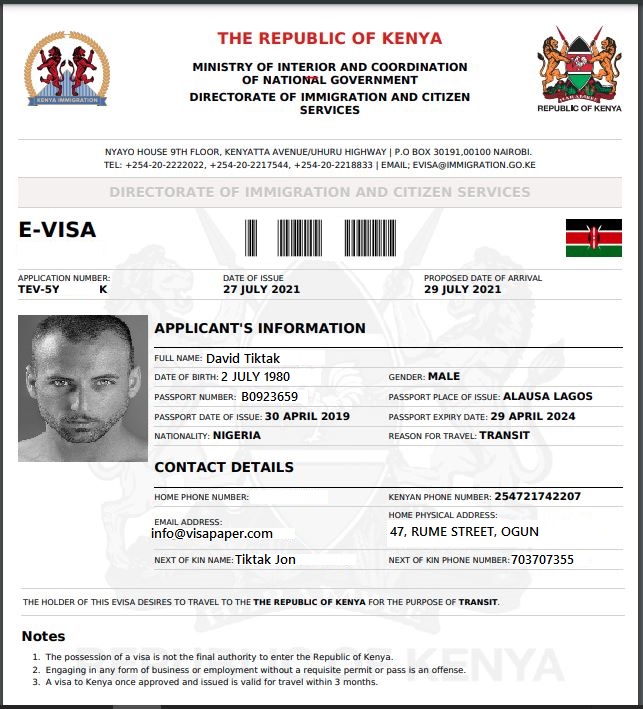
Kenya Visa
Example of Kenya Visa

What is a Kenyan Visa

A Kenyan Visa is an authorized document issued by the Kenyan government that permits a foreign citizen to enter and dwell in Kenya for a defined period, typically for tourism, business, or other purposes, and is usually acquired through an application process, either online or at a Kenyan embassy, demanding passport details and other supporting documents; most generally referred to as an “eTA” (Electronic Travel Authorization) in Kenya which can be applied for electronically before travel.

Kenya Visa Application

A Kenyan visa is required by visitors traveling to Kenya except those holding a re-entry pass to Kenya and citizens of Ethiopia, San Marino, Turkey, and Uruguay. A valid passport with a sufficient number of unused pages for endorsements abroad is also vital. The passport must be signed and valid for at least six months.

Other Kenya visa requirements are a visa application form completed and signed by the applicant, two passport-size photographs attached to the application form, valid round-trip ticket or a letter from a travel agent certifying that the applicant holds prepaid arrangements.

Furthermore required is a self-addressed stamped envelope for express mail, courier or registered mail if the visa is urgently required. Metered stamps are not acceptable. Also, provide home and work telephone numbers, and enclose the photographs and payment to avoid delay.

Visa fees payable by cash to the Embassy of Kenya — multiple entry visa $100 (Sh8,000), single journey visa $50 (Sh4,000), transit visa at entry $20 (Sh1,600). Multiple entry visas are normally issued for six months. )

Types of Kenya Visas

  • Single Journey Visa: Given for Single or Multiple access to persons whose nationalities require visas to enter Kenya.
  • Transit Visa: Issued for periods not exceeding three days to persons whose nationalities require visas to enter Kenya and who intend to transit through Kenya to a different destination.
  • Diplomatic Visa: Given for Single or Multiple entries to holders of Diplomatic passports who are on official duty. Coming Soon
  • Courtesy/ Official Visa: Issued to persons holding Official or Service passports on Official duty and to Ordinary passport holders who are not permitted to a Diplomatic visa; but where it is regarded by the Director to be desirable on the grounds of international courtesy. Coming Soon
  • East Africa Tourist Visa: This is a joint tourist visa that entitles holders to travel to and within the Republic of Kenya, the Republic of Rwanda, and the Republic of Uganda for tourism. Validity of East Africa Tourist Visa: 90 (Ninety days) Multiple Entry. Coming Soon

Kenya Visa Requirements

Based on your country of residence and citizenships the following may also be required:

  • Financial assets / bank letter(s)

Based on your purpose of visit the following may also be required:

  • Letter and/or appointment letter from the referring doctor/hospital
  • Conference invitation/participation letter
  • Employment contract
  • Supporting documents for resettlement
  • Vaccination(s) or test results certificates

For travelers arriving for business

  • Invitation letter from company
  • Copy of registration of the company

For travellers visiting family

  • Invitation letter from family/host
  • Identity card/Passport/Alien card/Entry permit of the family member/host

For Diplomatic travel

  • A Diplomatic, Official, and Service passport
  • An official letter from the Country of Origin/Organisation/ Foreign Affairs.

Processing time is three (3) working days while in some cases it may take longer.

Kenya Visa fees

Kenya is visa-free as of January 2024, though travelers must obtain an Electronic Travel Authorization (eTA) at least 72 hours before their travel. The eTA fee is $30 and is the same for all eligible nationalities. 

Kenya Visa-Free Countries

However, nationals of the following countries do not require Kenyan visas to enter Kenya.

  • Barbados
  • Belize
  • Botswana
  • Brunei Darusssalam
  • Burundi
  • Cyprus
  • Dominica
  • Fiji Island
  • Ghana
  • Grenada
  • Jamaica
  • Kiribati
  • Lesotho
  • Malawi
  • Malaysia (For less than 30 days stay)
  • Swaziland
  • Seychelles
  • Tanzania
  • The Bahamas
  • The Gambia
  • Zimbabwe
  • Maldives
  • Mauritius
  • Namibia
  • Nauru
  • Papua New Guinea
  • Rwanda
  • Samoa
  • Sierra Leone
  • Singapore
  • Solomon Islands
  • South Africa (For less than 30 days stay)
  • St. Kitts and Navis
  • St. Lucia
  • St. Vincent and the Grenadines
  • Tonga
  • Trinidad and Tobago
  • Tuvalu
  • Uganda
  • Vanuatu
  • Zambia

For those whose country doesn’t appear in the list above, visas can be obtained at Kenya Airports upon arrival. It’s advisable to obtain the visa from the Kenyan Embassy/Kenya High Commission in your country before departure. * Note: The list of countries shown above is subject to change

Kenya Visa for U.S. citizens

US citizens do not need a visa to visit Kenya, though they do require an electronic travel authorization (ETA). You can apply for an ETA online at www.ecitizen.go.ke.

Kenya Visa Application Form

The Kenya visa application form is unrestricted online at www.ecitizen.go.ke. You can apply for a Kenya Electronic Travel Authorization (eTA) through this portal.
Filed Under: About Kenya Tagged With: Kenya Visa Requirements

Akamba Tribe Guide: History, Clans, Culture, Music & Witchcraft

February 6, 2025 by Robert Njora

Kamba | Akamba Tribe

The Kamba or Akamba people are a Bantu ethnic tribe or group who live in the semi-arid formerly Eastern Province of Kenya which stretches east from Nairobi to Tsavo and north up to Embu, Kenya. This land is called Ukambani which constitutes of Machakos County Makueni County and Kitui County.

Sources vary on whether Kambas are the third, fourth, or fifth largest ethnic group in Kenya. The ethnic group makes up 11 percent of Kenya’s population. They speak the Bantu Kikamba language as a mother tongue. They are predominantly based in Machakos, Kitui, and Makueni Counties of Kenya. Approximately, the total population of the Kamba stands at 4.1 million. The Kamba are also called Akamba or Wakamba.

Origin and History of The Kamba | Akamba People

The first group settled in present-day Mbooni Hills in the Machakos District of Kenya in the second half of the 17th century before spreading to the greater Machakos, Makueni and Kitui Districts.

Other authorities suggest that they arrived in their present lowlands east of Mount Kenya area of inhabitation from earlier settlements further to the north and east, while others argue that the Kamba, along with their closely related Eastern Bantu neighbors the Kikuyu, Embu, Mbeere, and Meru moved into Kenya from points further south.

It is believed that the Akamba bore a son ‘Kikuyu’ (a boy named after the figtree) who married Mumbi (Creator) and together started the first Kikuyu family which is today the Kikuyu tribe.In colonial times the Akamba were highly considered by the British for their intelligence and fighting ability and were drafted in large numbers into the British army. Thousands lost their lives in WWI.

When it came to land, however, the British were not quite so respectful and tried to limit the number of cattle the Akamba could own (by confiscating them) and also settled more Europeans in Ukambani. The Akamba response was the formation of the Ukamba Members Association, which marched to Nairobi and squatted peacefully at Kariokor Market in protest. After three weeks the administration gave way and the cattle were ultimately returned to the people.

Akamba People
Akamba People

List of Kamba Clans

  • Aombe (Mwĩombe)
  • Aiîni (Mūiniînî)
  • Anzaũnĩ (Mũnzaũnĩ)
  • Anziũnĩ ( Mũnziũ)
  • Akĩthumba ( Mukĩ thumba)
  • Ambua (Mũmbua)
  • Amuti (Mũmuti)
  • Atwii (Mũtwii)
  • Ethanga (Mwĩthanga)
  • Atangwa ( Mũtangwa )
  • Akĩtutu (Mũkĩtutu)
  • Akĩtondo (Mũkĩtondo)
  • Amũumo( Mũmũumo)
  • Amũũnda ( Mũmũũnda)
  • Aewani (Mũewanĩ)
  • Amũtei (Mũmũtei)

Kamba Tribe – Kamba | Akamba Language

The Kamba speak the Kamba language (also known as Kikamba) as a mother tongue. It belongs to the Bantu branch of the Niger-Congo language family. Interestingly, Kikamba has no letters “c”, “f”, “j”, ‘r’, ‘x’ and ‘q’ in its alphabet.

Kamba Language – Kamba | Akamba Naming and Kamba Names

Naming of children is an important aspect of the Akamba people. In most but not all cases, the first four children, two boys, and two girls, are named after the grandparents on both sides of the family. The first boy is named after the paternal grandfather and the second after the maternal grandfather. Girls are similarly named.

Because of the respect that the Kamba people observe between the varied relationships, there are people with whom they cannot speak in “first name” terms.

  • The father and the mother-in-law on the husband’s side, for instance, can never address their daughter-in-law by her first name. Neither can she address them by their first names. Yet she has to name her children after them. To solve this problem, a system of naming was adopted that gave names that were descriptive of the quality or career of the grandparents.

Therefore, when a woman is married into a family, she is given a family name (some sort of baptismal name), such as “Syomunyithya/ng’a Mutunga,” that is, “she who is to be the mother of Munyithya/Mutunga.” Her first son is to be called by this name. This name Munyithya was descriptive of certain qualities of the paternal grandfather or of his career. Thus, when she is calling her son, she would indeed be calling her father-in-law, but at the same time strictly observing the cultural law of never addressing her in-laws by their first names.

After these four children are named, whose names were more or less predetermined, other children could be given any other names, sometimes after other relatives and/or family friends on both sides of the family. Occasionally, children were given names that were descriptive of the circumstances under which they were born;

  • “Nduku” (girl) and “Mutuku” (boy) meaning born at night,
  • “Kioko” (boy) born in the morning,
  • “Mumbua/Syombua” (girl)and “Wambua” (boy) for the time of rain,
  • “Wayua” (girl) for the time of famine,
  • “Makau” (boy) for the time of war,
  • “Musyoka/Kasyuko/Musyoki” (boy) and “Kasyoka/Kasyoki” (girl) as a re-incarnation of a dead family member,
  • “Mutua” (boy) and “Mutuo/Mwikali” (girl)as indicative of the long duration the parents had waited for this child, or a lengthy period of gestation.
  • “Munyao”(boy) for the time of famine
  • “Waeni” (girl) for the time of visitors
  • ‘Maundu”(boy) for the time of multiple activities/things

Children were also given affectionate names as expressions of what their parents wished them to be in life. Such names would be like

  • “Mutongoi” (leader),
  • “Musili” (judge),
  • “Muthui” (the rich one),
  • “Ngumbau” (hero, the brave one).

Of course, some of these names could be simply expressive of the qualities displayed by the man or woman after whom they were named. Very rarely, a boy may be given the name “Musumbi” (meaning “king”).

Kamba | Akamba Tribe – Culture

All adolescents go through initiation rites to adulthood at around the age of 12 and have the same age-set groups common to many of Kenya’s people. The various age-set rituals involve the men, and the women to a lesser extent, gaining seniority as they get older. Young parents are known as ‘junior elders’ (mwanake for men, mwiitu for women) and are responsible for the maintenance and upkeep of the village.

Once his children are old enough to become junior elders. Themselves, the mwanake goes through a ceremony to become a ‘medium elder’ (nthele), and later in life a ‘full elder’ (atumia ma kivalo) with the responsibility for death ceremonies and administering the law. The last stage of a person’s life is that of a ‘senior elder’ (atumia ma kisuka) with responsibility for the holy places. Akamba subgroups include Kitui, Masaku, and Mumoni.

Kamba | Akamba Tribe – Clothing and Costumery

The Akamba of the modern times, like most people in Kenya, dress rather conventionally in Western / European clothing. The men wear trousers and shirts. Young boys will, as a rule, wear shorts and short-sleeved shirts, usually in cotton, or tee-shirts. Traditionally, Akamba men wore leather short kilts made from animal skins or tree bark. They wore copious jewelry, mainly of copper and brass.

It consisted of neck chains, bracelets, and anklets. The women in modern Akamba society also dress in European fashion, taking their pick from dresses, skirts, trousers, jeans, and shorts, made from the wide range of fabrics available in Kenya. Primarily, however, skirts are the customary and respectable mode of dress.

They shaved their heads clean and wore a headband intensively decorated with beads. The various kilumi or dance groups wore similar colors and patterns on their beadwork to distinguish themselves from other groups. Traditionally, both men and women wore leather sandals especially when they ventured out of their neighborhood to go to the market or on visits. While at home or working in their fields, however, they remained barefoot.

School children, male and female, shave their heads to maintain the spirit of uniformity and equality. Currently, the most popular Kamba artists include; Ken Wamaria, Kativui, Kitunguu, etc. Ken Wamaria is rated as the top artist in Ukambani and the richest Kenyan artist (Kioko, 2012).

Kamba Language – Kikamba music

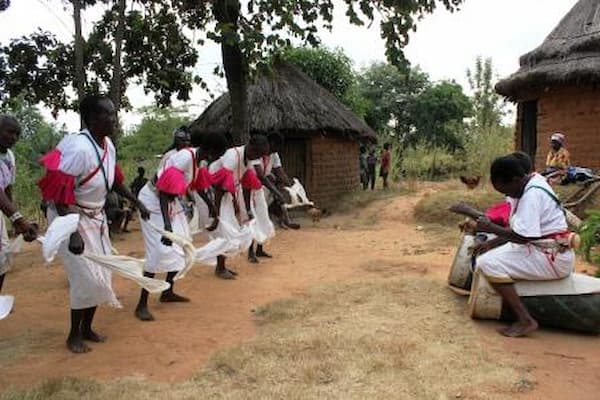
The Akamba people’s love of music and dance is evidenced in their spectacular performances at many events in their daily lives or on occasions of regional and national importance. In their dances, they display agility and athletic skills as they perform acrobatics and body movements. The Akamba dance techniques and style resemble those of the Batutsi of Rwanda-Burundi and the Aembu of Kenya.

The earliest, most famous, and respected traditional Kamba soloist who can be documented was Mailu Mboo (grandfather to Influx Swaggaa top Kenyan Artiste) who came from “Kwa Vara” now Mwingi. Dances are usually accompanied by songs composed for the occasion (marriage, birth, nationally important occasion), and reflect the traditional structure of the Kikamba song, sung on a pentatonic scale.

The singing is lively and tuneful. Songs are composed of satirizing deviant behavior, anti-social activity, etc. The Akamba have famous work songs, such as Ngulu Mwelela, sung while work, such as digging, is going on. Herdsmen and boys have different songs, as do young people and old. During the Mbalya dances the dance leader will compose love songs and satirical numbers, to tease and entertain his / her dancers.

Some of the Kamba songs include

  • Mwali (plural Myali), is a dance accompanying a song, the latter which is usually made to criticize anti-social behavior.
  • Kilumi and Ngoma, religious dances, performed at healing and rain-making ceremonies;
  • Mwilu is a circumcision dance;
  • Mbalya or Ngutha is a dance for young people who meet to entertain themselves after the day’s chores are done.
  • Kamandiko, or the modern disco usually held after a wedding party.

Kamba | Akamba Tribe – Economy

The Akamba were great traders and ranged all the way from the coast to Lake Victoria and up to Lake Turkana. Ivory was one of the main barter items but locally made products such as beer, honey, iron weapons, and ornaments were also traded. They used to obtain food stocks from the neighboring Maasai and Kikuyu, as their own low-altitude land was relatively poor and couldn’t sustain the increasing population that followed their arrival in the area.

Over time, the Akamba expanded their commercial activity and wielded economic control across the central part of the land that was thereafter to be known as Kenya (from the Kikamba, ‘Kiinyaa’, meaning ‘the Ostrich Country’ derived from the reference they made to Mount Kenya and its snow cap similar to the male Ostrich), from the Indian Ocean in the east to Lake Victoria in the west, and all the way up to Lake Turkana on the northern frontier.

The Akamba traded in locally produced goods such as sugar cane wine, ivory, brass amulets, tools, weapons, millet, and cattle. The food obtained from trading helped offset shortages caused by droughts and famines experienced in their Kamba land. In the mid-eighteenth century, a large number of Akamba pastoral groups moved eastwards from the Tsavo and Kibwezi areas to the coast. This migration was the result of extensive drought and a lack of pasture for their cattle.

Kamba Witchcraft

Kamba witchcraft is a type of Bantu witchcraft that involves the use of charms, spells, and “muti” to achieve a client’s goals. According to Kamba, they don’t want to marry the daughters of witches. Therefore, witches’ daughters usually marry poor men with few cattle. The bride-wealth paid for a witch’s daughter is less than normal.

Characteristics of witches

Witches are all women and their magical power (uoi or woman’s uoi, uoiwa mundu muka) is inherited through the female line by doing a specific ritual in which mother and daughter join and shake their buttocks together, chanting a spell. Witches’ sons do not inherit uoi at all. They are not regarded as witches. Kamba witchcraft is deeply involved with femininity.

Also, witches do not use any magical medicines (miti, ndawa) or fetishes (ithitu). People explain that witches hide these kinds of things. They bewitch people by just scratching their buttocks or saying some suggestive words such as “You will see later.” Witches’ magical power originates from the inside of their bodies, specifically their genital organs, not from medicine men or others.

They cause people many kinds of misfortunes such as disease, wounds, sterility, death, and loss of work. Witches can also cause ‘disease, death, and sterility among livestock and the devastation of crops.

Filed Under: Tribes Tagged With: Famous Ethnic Groups in Kenya

Food in Kenya Guide: Traditional Dishes, Snacks and Ugali Kenya

February 6, 2025 by Mercy Chumba

Food in Kenya

The main staples of Kenyan food and cuisine are: Maize meal (called Ugali when cooked and unga when raw) and rice. A typical day in Kenya would mean breakfast, tea (chai) at 10 a.m., lunch, tea at 4 p.m., and dinner. Kenyan cuisine is built around fresh, readily available, and relatively inexpensive ingredients. The produce that grows in the region, such as cabbage, tomatoes, beans, potatoes, kale, spinach, avocados, and other leafy greens, feature prominently in daily dishes.

Typically consumed animal proteins are goat meat, chicken, and beef, in that particular order. Along the coast, seafood such as prawns, kingfish, parrotfish, crab, crayfish, lobster, tuna, sailfish, and marlin are available and consumed in plenty. Rice, wheat, maize, corn meal, and millet and their flours are the starches of choice.

Breakfast is typically bread (mkate) or porridge (uji) with chai. Despite Kenya being recognized for its coffee (which is known for its distinctive wine-like flavor) the hot beverage of choice among the locals is tea. Drawing from the Indian connection, the tea had is Chai, a milky, sweet tea that is had at breakfast and during morning tea time and evening tea time.

Lunch is Ugali (cornmeal/maize meal boiled in water to the consistency of a paste and made into a dough – think polenta) with vegetable (maharagwe) or meat stew. Sukuma Wiki (roughly translated means “to get you through to the end of the week”), a braised leafy greens dish made with onions, tomatoes, garlic, and coriander is also lunch fare.

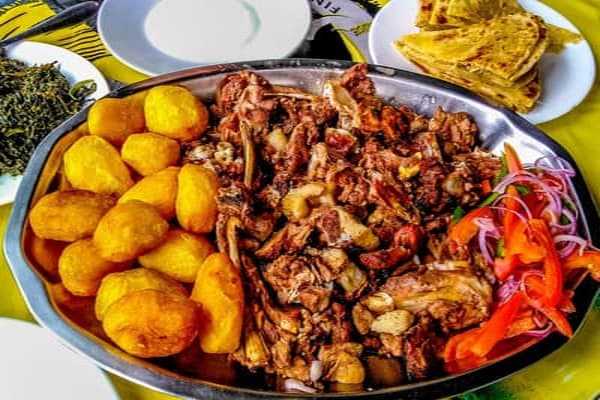
Kachumbari is also a salsa-like condiment that is made of tomatoes, onions, coriander, pepper, and lemon juice. For dinner, it is served as an accompaniment with grilled meat dishes such as Nyama Choma (literally “burnt meat”) which is perhaps one of the more famous dishes and is grilled skewers of goat meat or beef (less frequently, chicken).

Food in Kenya Image
Food in Kenya

List of food in Kenya

  • Nyama Choma
  • Ugali
  • Githeri
  • Sukuma wiki
  • Chapati
  • Pilau
  • Mandazi
  • Mutura
  • Mukimo
  • IRIO
  • Kenyan stew
  • Bhajias
  • Biryani
  • Chips mayai
  • Kuku Paka
  • Masala chai
  • Githeri (beans and corn)
  • Kenyan cuisine
  • Maharagwe
  • Mashed potatoes and peas
  • Mukimo (mashed dish)
  • Samosas

Traditional Food in Kenya

Here are the 10 traditional Kenyan dishes you have to try.

Ugali

  • Ugali is one of Kenya’s most common staple foods. Cornmeal is added to boiling water and cooked until a paste is formed. It is thick with a granular dough-like consistency. This makes it the perfect complement to the saucy stews and vegetables Kenyans eat it with.

Sukuma Wiki

  • Sukuma Wiki is a Kenyan dish that’s made with kale and diced tomatoes. They are simmered with chopped tomato and onion and spiced with mchuzi mix (Kenyan flavoring salt). The Kenyan dish is made with a variety of leaves, including pumpkin and sweet potato leaves.

Kenyan Pilau

  • Pilau is a traditional, beautiful scented rice dish made with many aromatic spices that add an amazing depth of flavor to the rice. It can also be made with either beef or chicken. It has a wonderful balance of flavors. It is a festive dish, which is never missing during special occasions or events.

Nyama Choma

  • Nyama Choma incorporates two words: ‘nyama’ which means meat and ‘choma’ which means barbecued in English. It is a traditional meat dish from Kenya and can be made with goat meat, lamb, or beef.
  • The origin of the dish traces back to the Massai people as they immigrated from North to East Africa. It is usually served with ugali and kachumbari (a fresh onion and tomato salad).

Mandazi

  • Mandazi can only be defined as the Kenyan doughnut, making it one of our favorite Kenyan dishes by far. It is one of the principal dishes in the cuisine of the Swahili people who inhabit the Coastal Region of Kenya and Tanzania.
  • The dish is popular in the region, as it is convenient to make, can be eaten with almost any food or dips or just as a snack by itself, and can be saved and reheated for later consumption

Githeri

  • Githeri is a traditional Kenyan meal consisting of maize and legumes (primarily beans) mixed and boiled together. The maize and beans are mixed in a sufuria, a type of pot, with water added, and the mixture is boiled until completely cooked.
  • The addition of salt, chili, pepper, and chapati as an accompaniment makes this a simple, delicious, and nutritious dish.

Wali wa Nazi

  • It is mainly eaten along the Indian Ocean island coast. Wali wa nazi is a starchy side dish consisting of rice cooked in a combination of coconut milk and water. It is usually seasoned only with salt and is usually served as an accompaniment to different curries or chicken, fish, and meat dishes.

Matoke

  • Matoke is a traditional dish from Kenya made with green bananas (a type of banana). It is traditionally cooked with a combination of spices and frequently served as a hearty side dish. The food can be enjoyed alongside rice or on by themselves.

Maharagwe

  • Maharagwe is a traditional Kenyan dish consisting of red kidney beans cooked in a rich, flavorful sauce made with tomatoes, onions, coconut milk, and spices, usually served with ugali (a maize porridge), chapati, or rice
  • It is considered a staple Swahili dish and is known for its mild spice profile compared to other Indian-influenced bean dishes.

Kenyan Chapati

  • Kenyan Chapatis are a beloved staple in Kenyan cuisine, best known for their softness, flaky texture, and rich flavor. This flatbread, with its origins in Indian cuisine, has been warmly embraced and adapted by Kenyan cooks, making it a common accompaniment to different dishes such as stews, curries, and vegetables.
  • The preparation of chapati involves kneading dough made from wheat flour, water, and oil, which is then rolled into thin layers and cooked on a hot griddle until golden brown.

Kenyan Hot Snacks and Fast Food

Here are the 10 Kenyan Hot Snacks and Fast Food you should try;

KFC

  • KFC, or Kentucky Fried Chicken, is a fast food chain that has been in Kenya since 2011. KFC’s entry in Kenya is a continuation of a long family tradition. Mr Schaffer’s family has been a KFC franchisee for over 30 years when his father opened the first store in South Africa, and where he spent two years learning everything that he knows about the brand.
  • It consists of two-piece chicken and fries (chips). It is a popular fast food name owing to its signature fried chicken made with a secret recipe of 11 herbs and spices.

Pizza Inn

  • Pizza Inn in Kenya is a fast food restaurant chain mainly serving pizza, considered the leading pizza brand in the country. The first Pizza Inn opened in Nairobi, Kenya, in October 1998.
  • As the leading pizza brand in Kenya, Pizza Inn provides Kenya’s signature pizza offerings. Our Pizza pies, Wings, Pizzas, and other sides are made using only the freshest, locally sourced ingredients.

Samosa

  • Samosa is a fried pastry snack, usually with a filling of spiced potatoes, minced meat (beef, chicken), or lentils for a vegetarian option.

Mahamri

  • Mahamri is a breakfast from the Kenyan Coastal Region. It’s like a doughnut but it is flavored with coconut and cardamom powder. They are usually triangular or sometimes round. Generally, they are enjoyed as a breakfast item on their own with tea or coffee or with mbaazi.
  • Mahamri is also served along with stews and curries as part of the main meal.

Mutura (Kenyan Sausage)

  • Mutura is a Kenyan spiced goat or beef sausage enriched with blood and then grilled over an open flame. It has a smoky, spicy flavor and is often eaten at night.

Bhajia

  • This is the most enjoyed snack in Kenya. They are basically potato fritters coated with chickpea flour. This recipe consists of thinly sliced potatoes mixed into a thick batter made from rice and gram flour (chickpea flour), spices, and herbs, then fried until golden.
  • They may also be served with a side of salad and a slice of lemon, or with mango chutney. In Kenya, they are usually served with a cold refreshing drink.

Viazi Karai

  • Viazi Karai is one of the most famous coastal dishes known for its tantalizing taste. It is one such dish and it’s sold in almost every street corner and is consumed almost faster than it’s cooked.

Smokie Pasua

  • It is a type of ready-to-eat smoked sausage that can be made of pork, beef, chicken, or a blend of all these meats and other flavourful inclusions.

Chips Masala

  • Chips Masala is a famous dish on most restaurant menus in Kenya. They are easy to make, spicy, and tasty. It is a must to try out these chips when in Kenya.

Mayai Pasua

  • They are the most famous street food snacks for Kenyans because of their small price and provide an important protein boost to the day of predominantly poor people. They are called ‘Mayai pasua’ (literally ‘split eggs’).
  • Their recipe is simple: the hard-boiled egg is cut almost in half lengthwise, slightly opened, and stuffed with kachumbari, the classic salad of tomatoes, onions, and lemon juice, to which coriander is often added, especially on the side, and sometimes also green chili (the well-known pilipili).

Ugali Kenya Food

  • Ugali is a beloved staple dish in Kenya. It is like a porridge but much more densely made from white maize meal or maize flour. Ugali or Nsima as it is known in Kenya, is normally enjoyed with a vegetable and/or meat stew.

Ingredients

  • cup maize meal/corn meal
  • normal water

Instructions

  • Boil water until it bubbles. The water should be very hot. This ensures the ugali will cook perfectly
  • Also, add a cup full of flour to the water. Let it cook for a few seconds until water begins to cover the flour
  • Use a wooden spoon to quickly start mixing the flour and water
  • Add a handful of flour and continue to mix the water and flour it will start to come together
  • Reduce heat to medium and keep turning the ugali as it continues to stick together
  • Gather the ugali and press it onto the side of the sufuria
  • Place the wooden spoon under the ugali and form a ball in the middle of the sufuria
  • Repeat pressing the ugali on the side of the sufuria and turning it to the middle
  • Once the ugali has become firm, turn it once more and smoothen it into a round. You will know your ugali is ready once you start to smell the aroma clearly
  • Turn the ugali over onto a plate
  • Dip the wooden spoon into water and use it to smoothen the ugali into a round ball on the plate
  • Serve the ugali whole or slice. Enjoy with your favorite stew, meat, veggies, fish etc

Filed Under: About Kenya Tagged With: Famous Food in Kenya

Things to do in Kenya Guide: Best Activities, Family Fun, Budget Adventures & More

February 4, 2025 by Robert Njora

Kenya is a country in East Africa with a coastline on the Indian Ocean. It contains savannah, Lakelands, the dramatic Great Rift Valley, and mountain highlands. It’s also home to wildlife like lions, elephants, and rhinos. From Nairobi, the capital, safaris visit the Maasai Mara Reserve, known for its annual wildebeest migrations, and Amboseli National Park, offering views of Tanzania’s 5,895m Mt. Kilimanjaro. Here is a list of some of the best things to do in Kenya.

Things to do in Kenya

Best Things to Do in Kenya

Go on a Safari in the Maasai Mara National Reserve

Maasai Mara National Reserve is an area of maintained savannah wilderness in southwestern Kenya, along the Tanzanian border. Its creatures include lions, cheetahs, elephants, zebras, and hippos. Wildebeest transits its plains during their annual migration. The landscape has grassy plains and rolling hills and is crossed by the Mara and Talek rivers. You will experience the Great Migration (July-October) and witness the Big Five.

Visit Amboseli National Park

Amboseli National Park is in southern Kenya. It’s known for its extensive elephant herds and views of spacious Mount Kilimanjaro, across the border in Tanzania. Observation Hill presents pictures of the peak and the park’s plains and swamps.

Varied wildlife includes giraffes, zebras, cheetahs, and hundreds of bird species. The western section is monopolized by the vast Lake Amboseli, which is dry outside the rainy season.

Explore Tsavo National Parks

Tsavo East National Park is a national park in Kenya with an area of 13,747 km2 (5,308 sq mi). It was established in April 1948 and covers a semi-arid area previously known as the Taru Desert. The Tsavo River flows west to east through the national park, which is found in the Taita-Taveta County of the former Coast Province.

Discover Lake Nakuru

Lake Nakuru is one of the Rift Valley lakes, found at an elevation of 1,754 m (5,755 ft) above sea level. It lies to the south of Nakuru, in the Rift Valley of Kenya, and is covered by Lake Nakuru National Park. The lake’s plenty of algae used to attract a vast abundance of flamingos that famously lined the shore.

See Rhinos at Ol Pejeta Conservancy

The Ol Pejeta Conservancy is a 360 km2 (140 sq mi) not-for-profit wildlife protection in Central Kenya’s Laikipia County. It is situated on the equator west of Nanyuki, between the foothills of the Aberdares and Mount Kenya. The Ol Pejeta Conservancy operates to conserve wildlife and provide a refuge for great apes.

Relax at Diani Beach

Diani Beach is a beach on the Indian Ocean coast of Kenya. It is found 30 kilometers (19 mi) south of Mombasa, in Kwale County. You will enjoy Snorkeling, Kite surfing, and Wildlife spotting.

Rock climbing: Fischer’s Tower – Hell’s Gate National Park

You don’t need much if any, rock-climbing experience to scale Fischer’s Tower, the main attraction in Hell’s Gate National Park. Simply pitch up, pay a very modest fee, and the obliging climbing guide will fit you up with ropes, shoes, and the other tricks of the trade. And then he/she will teach you how to climb this 25m-high jagged volcanic plug.

All that remains of an ancient volcano, the rock is named after the German explorer, Gustav Fischer, who passed this way in 1883. According to local Maasai tradition, the rock is the petrified figure of a chief’s daughter who turned around against the dictates of tradition to take one last look at her home before leaving to be married.

Be warned, however, while making the climb, you are likely to come face to face with the elephant’s closest relative – the diminutive and very inquisitive rock hyrax, a colony of which have made the rock their home. Hell’s Gate National Park is 100km north of Nairobi and immediately adjacent to Lake Naivasha.

For more information visit: Hell’s Gate National Park

Horseracing: Ngong Racecourse

For a relaxed, colorful and typically ‘Nairobi’ day out, you can’t beat the classic ‘day at the races’. Ngong Racecourse and Golf Park have been rated as one of the most beautiful in the world, standing as it does in the lee of the famous Ngong Hills of ‘Out of Africa’ fame. It is also Africa’s most venerable. Horseracing first began in Kenya in 1904 when Somali ponies were raced around a track in the, then, the little town of Machakos.

Thoroughbred racing began in Nairobi in 1914, and apart from the interruption caused by two world wars, has continued ever since. Run by the Jockey Club of Kenya, the Ngong track is a classic ‘British Oval’ 2,400m in circumference with a 1,200m ‘straight’.

An average of 25 race meetings is held annually on alternate Sundays. Easily the most famous race is the Kenyan Derby, which is held in April. Interestingly the track has also been used for ostrich racing.

Zip-Lining: Kereita Forest

Kenya is home to some of the last remaining stands of primeval forests on earth, and to get a bird’s eye view of them you might like to try out some zip-lining. If so, head for The Forest, an extreme sports center less than an hour’s drive outside Nairobi where you can zip up your adrenalin on East Africa’s longest zip-line tour, which jumps across a series of forested hills with a combined length of 2,200 meters. The Forest also offers the madness of paintballing and the rather more calming sport of archery. For further information visit: Kereita Forest

Jump off a Cliff: Ngare Ndare Forest

Well yes, you can: literally. Amid the leafy green vaults of the magical Ngare Ndare Forest, you can (with supervision) jump off a cliff into a rock pool, swing across a rope bridge above wallowing elephants, go rock climbing, or throw yourself into a canyon. Or you can simply go for a walk amid 200-year-old African olive and red cedar trees. An ecological stronghold, the Ngare Ndare Forest stands at the foot of Mount Kenya.

Climb a Volcano Mountain: Mount Longonot

Things to do in Kenya – Mt Longonot National Park ‘The scene was of such an astounding character that I was completely fascinated and felt under an almost irresistible impulse madly to plunge into the fearful chasm’. So spoke the famous African explorer, Joseph Thomson as he made the first recorded ascent to the rim of Mount Longonot in 1884. The mightiest of the Rift Valley volcanoes, Longonot towers some 2,776 meters above the waters of bewitching Lake Naivasha.

As to climbing it – there is a well-defined track that leads, in around 45 minutes of steep scrambling, to the rim. Once on top, you can either absorb the view – which is a stunner, encompassing both the distant Aberdares Range and the Mau Escarpment – or you can strike off around the rim, the entire circuit of which takes around 3 hours.

Technically dormant, but better described as ‘senile’, Longonot is a relatively young volcano, having been formed within the last 400-600 years. And, while seemingly peaceful, only several thousand meters below its surface the groundwater seethes at an incredible 304°C (one of the hottest temperatures on earth).

Much of this energy has now been harnessed to the nearby Olkaria Geothermal Project in Hell’s Gate National Park, but the hot thermals rising above the mountain still have sufficient power to deflect the path of light aircraft flying overhead. Longonot stands within its own national park, 90km northwest of Nairobi.

For further information visit: Mount Longonot National Park

Paragliding: Kerio Valley

For the ultimate in paragliding experiences, you have to head for the Kerio Valley. A forgotten Eden with seemingly perpetual blue skies, the Kerio Valley is a seldom-visited and exquisitely beautiful gem.

A branch of its more famous cousin, the Great Rift Valley, the Kerio Valley drops a spectacular 1,219 meters between the Tuyen Hills and the Elgeyo Escarpment. 80km long and only 10km at its widest, on its upper slopes is a tangle of semi-tropical vegetation; in its sweltering bottom, there’s an only dry bush, elephant, buffalo, the meanderings of the crocodile-packed Kerio River and the beautiful oval of Lake Kamnarok.

A typical paraglide will last a couple of hours and cover ten kilometers – but during that time you can look down on Tiati, the sacred mountain of the Pokot people, the ancient Neolithic furrows of the enigmatic Sirikwa people, and the shimmering heat and dust of the Rimoi Game Reserve – which is probably Kenya’s wildest. And if paragliding is a little too edgy for you – the Kerio Valley also offers trekking, hiking and mountain biking.

The Kerio Valley is 500 km’s from Nairobi.

Other Things to Do in Kenya

Diving At The Coast

The best places for diving in Kenya will be found in the numerous marine reserves. From Malindi to Shimoni, scuba diving and snorkeling are the norms in the midst of some of the most beautiful coral reefs in the world. Watamu and Wasini island have some of the most spectacular snorkeling experiences.

Mountain Climbing And Trekking

Mount Kenya, the second-highest mountain in Africa is popular for trekking safaris, so are the Ngong hills close to the capital city of Nairobi. The scenic view is bound to be a moving experience for any visitor to the country.

Balloon Safari

A balloon safari over the vast savanna plains of Kenya Maasai Mara complete with a view of the animals in their natural habitat is an experience that will never leave you.

Fishing

There are exceptional opportunities for trout fishing, especially in the Mount Kenya and Aberdare regions in the central parts of the country. Nile Perch fishing takes place in Lake Victoria and the Lake Turkana regions.

River Rafting / White-water Rafting

The best times for rafting in Kenya are late October to mid-January, and from early April to late July. There are plenty of rapids, waterfalls and chutes on the Athi/Galana and Tana Rivers as well as on the Ewaso Nyiro river near Isiolo.

Cycling / Mountain Biking

Mountain biking and cycling trips at the Hell’s Gate National Park around the great Rift Valley region are great breathtaking experiences.

Bird Watching

Take a breathtaking view of a variety of birds at Rusinga Island, Lake Nakuru and Lake Bogoria.

Daphne Sheldrick

The Sheldrick Wildlife Trust is located at the Nairobi National Park and serves as an orphanage for baby elephants as well as some rhinos.

Giraffe Center

The Giraffe Center is an amazing place to visit. The center was built initially as a rehabilitation project to rescue the Rothschild Giraffe. It is home to a number of endangered species and a unique ecosystem.

Mamba Village

Nairobi Mamba Village is located in Nairobi’s leafy Karen suburb, about 13 kilometers away from the city center. Mamba Village is famous for its Crocodile Farm.

Paint Balling

Paintballing is a warlike game where guns are substituted with air pressure has driven paintballs, which burst on impact! Enjoy some paintballing action at Paintball Fury- Karen, Jungle Paintball Kenya – City Park or at Kitengela Paintball Polo.

Archery

Kenya Archery Association is the official national Archery association. Archery training grounds include: Twiga Centre- Parklands Sports Club, Strathmore Univesity Grounds, and East Africa Bow Sports Ltd

Horse Riding

You can catch some horse-riding and horse-racing action at the Ngong Race Course or the Thigiri Riding School.

Water-slides

Slide, spin, soar and plunge into the water. Enjoy water slide at Splash Waterworld Lanagata, Nairobi; or Wild Waters Nyali, Mombasa

Quad bike

You can drive down to Lukenya Motorcross on the outskirts of Nairobi for Quad biking, or head out further to the Hells Gate National Park in Naivasha about an hours drive from Nairobi.

Ice Skating

The Panari Hotel along Mombasa Road has an ice-skating rink for ice skating lovers or get to even learn how to play Ice Hockey.

Go Karting

Experience the rush of adrenaline as you take sharp corners in a kart at high speeds around the track at GP – Karting at Splash Langata or at Go Kart, Mombasa.

Things to do in Kenya with kids

  • Visit the Giraffe Centre (Nairobi) – Let kids feed and interact with endangered Rothschild giraffes.
  • David Sheldrick Elephant Orphanage (Nairobi) – Watch baby elephants being fed and playing in the mud.
  • Nairobi National Park – A game drive close to the city with lions, giraffes, rhinos, and more.
  • Lake Naivasha Boat Ride – Spot hippos and birds while enjoying a peaceful boat safari.
  • Hell’s Gate National Park – Family-friendly hiking and biking with breathtaking landscapes.
  • Animal Orphanage (Nairobi) – See rescued animals up close.

Things to do in Kenya other than safari

  • Relax at Diani Beach – Relish the beautiful white sand beaches of Diani, a popular coastal destination.
  • Hike Mount Kenya: Explore the spectacular landscape of Mount Kenya, a significant peak in Africa.
  • Explore Lamu Island – A UNESCO-listed Swahili town with rich history.
  • Snorkel or Dive at Watamu Marine Park – See colorful coral reefs and marine life.
  • Take a Sunset Dhow Cruise in Mombasa – A relaxing sail along the coast.
  • Visit Chale Island – A private island with gorgeous beaches and mangroves.

Things to do in Kenya on a budget

  • Walk Through Karura Forest (Nairobi) – Entry: ~Ksh 200 ($2).
  • Bike & Hike at Hell’s Gate National Park – Entry: ~Ksh 300 ($3).
  • Explore Oloolua Nature Trail (Karen, Nairobi) – Entry: ~Ksh 200 ($2).
  • Visit Paradise Lost (Kiambu) – Entry: ~Ksh 500 ($5)
  • Go to Uhuru Park (Nairobi) – Free entry; boat rides and relaxation in the city center.
  • Swim at Fourteen Falls (Thika) – Entry: ~Ksh 200 ($2)

Filed Under: About Kenya, Tourist Attractions in Kenya Tagged With: Famous Things to Do in Kenya

Kenyan Passport Guide: Renewal, Application Process, and Passport Types

February 4, 2025 by Robert Njora

Kenyan Passport

A Kenyan passport is a travel document that is issued by Kenya‘s government to its citizens, which verifies the identity and nationality of its holder essentially for international travel. The Kenya passport is issued to Kenya citizens in line with the Constitution of Kenya, 2010, and as provided for in the Kenya Citizens and Immigration Act that commenced on 30 August 2011. In addition, the issuance process is regulated by Legal Notice No. 64.

Kenyan Passport
Kenyan Passport

On August 31, 2017, the government of Kenya rolled out the new generation Kenyan e-passport that is to replace the old ones still in circulation.

The three main differences between the current passport and the e-passport are:

  • Colors – navy blue vs sky blue;
  • The new generation passport has ‘East African Community’ engraved on it in addition to ‘ Republic of Kenya’ in line with the drive for regional integration; and
  • The smaller top right picture on the biodata page of the new generation passport has a map of Kenya engraved on it, unlike the current one which is some random circle.

Kenyan Passport Fees

Passport TypeAmount (Kshs)
32 Pages Ordinary “A” SeriesKshs. 4,550
48 pages Ordinary “B” SeriesKshs. 6,050
64 Pages Ordinary “C” SeriesKshs. 7,550
Diplomatic passport (48 pages)Kshs 15,000
Mutilated PassportKshs 10,050
Replacement of a lost passport:
East African Passport
Service passport
Express passport
Kshs 20,000
Kshs 990
Kshs 6000
Kshs 30,000

Kenyan Passport Renewal

The application must be recommended by a citizen of Kenya, who is not a relative of the applicant.

  • To renew your passport, login to your eCitizen (or register for an account if you don’t have one already)
  • Click on immigration Kenya e-Passport application form Once you get the form, fill it with all the details required. You don’t have to answer the questions at once, but ensure the details are right.
  • Choose the mode of payment – The available options include M-Pesa Paybill, mobile money, Airtel Money, debit cards, and credit cards
  • Print & download your application form
  • Submit the application form

Requirements during submission

  • Applicants MUST appear in person for Biometric Enrolment
  • An eCitizen pre-filled passport application form and three invoices
  • Original birth certificate and one photocopy
  • Original National ID Card and one photocopy
  • Three current passport-size photos
  • One photocopy of the recommender’s ID card
  • Old passport for replacement plus photocopies of its last three pages
  • Photocopies of parents’ National ID cards (if available) or Death Certificates (if deceased)
  • For a lost Passport, an affidavit, a police abstract, and an explanation letter are required
  • For a mutilated Passport, an explanation letter is required to explain the circumstances of the mutilation

Kenyan E-Passport

Application For Kenyan Passport

You can apply for a Kenyan passport and pay for it online. You’ll have to print out a form at the end. You must sign and date the form, including any documents or photographs that are mentioned, and return it for processing.

To apply for a Kenyan Passport;

  • Login or Register on www.ecitizen.go.ke
  • Go to immigration.ecitizen.go.ke and or Department of immigration services and select the passport application form.
  • Read the instructions thoroughly then fill the application form.
  • Select the mode of payment and pay for the passport fees(The current fees are listed above).
  • Download and print the application form and three of the receipts.
  • You will then submit the application form in person to the Immigration offices which are located in Nyayo House-Nairobi, Mombasa & Kisumu.

During the submission, the following will be required;

  • The eCitizen pre-filled passport application form and three receipts from the application process.
  • Original birth certificate and a photocopy of the same.
  • Original National ID Card and its copy.
  • Three Current passport size photos.
  • Recommender’s ID Card copy.
  • Consent letter for minors.
  • Parents’ National ID cards and their copies.

Kenyan Passport Deadline

The current passport was issued on 1 September 2017 and the old ordinary passport will be phased out by 1 March 2020 and they will be declared unusable and stop being acknowledged as travel documents.

Kenyan Passport Application Form

The official document can be acquired when making an application for a passport on the eCitizen, Immigration portal.

Kenyan Passport Visa-Free Countries

Below is a comprehensive list of the various countries you can travel to with a Kenyan Passport without producing a travel visa. Most of these countries will allow you passage and freedom for a specific duration of time after which you can then obtain a travel visa if you want to prolong your stay. These countries include;

  • Antigua and Barbuda – 1 month
  • Bahamas – 3 months
  • Barbados
  • Benin – 3 months
  • Botswana – 3 months
  • Burundi – 3 months
  • Dominica – 21 days
  • Ethiopia – 1 year
  • Fiji – 4 months
  • Gambia – 3 months
  • Ghana
  • Grenada
  • Haiti – 3 months
  • Indonesia – 30 days
  • Jamaica
  • Kiribati – 30 days
  • Lesotho – 90 days
  • Malawi – 90 days
  • Malaysia – 90 days
  • Mauritius – 90 days
  • Micronesia – 30 days
  • Namibia – 90 days
  • Panama – 180 days
  • Philippines – 30 days
  • Rwanda – 6 months
  • Saint Kitts and Nevis
  • Saint Vincent and the Grenadines 1 month
  • Senegal – 90 days
  • Singapore – 30 days
  • Swaziland – 30 days
  • Tanzania – 90 days
  • Trinidad and Tobago
  • Uganda
  • Vanuatu – 30 days
  • Zambia – 90 days
  • Zimbabwe – 3 months
  • Northern Cyprus
  • Palestine
  • South Ossetia
  • Transnistria
  • Hong Kong
  • Cook Islands – 31 days
  • Niue – 30 days
  • The British Virgin Islands
  • Cayman Islands
  • Montserrat
  • Pitcairn Islands

How To Renew Kenyan Passport In USA

You can apply for a new passport or replace your current passport through the above-mentioned method through the eCitizen portal (www.ecitizen.go.ke). You’ll have to download and print out a form at the end. Then sign and date the form, add the documents and photographs that are required and submit them in person at the Embassy (2249 R Street NW, WASHINGTON DC 20008) for biometric capture. Applicants can pay using mobile money, Credit, Debit Cards or online banking

Kenyan Passport Photo Size

The passport photo must be Coloured, Printed on photo quality paper and 2 x 2 inches (51 x 51 mm) in size.

Kenyan Passport Tracking

After you are done with the application and have submitted the forms what is left is to wait for the passport to be issued, to know if your Passport is ready;

  • Login to your eCitizen account (the one you used to make the application) and go to the Immigration services – recent applications, here you will be able to see the status of your application, whether it is accepted, rejected o0r ready for collection.
  • Via SMS through the shortcode 2032, to do this write a message with the number you were given at the time of application and send it to the code 2032. You should then receive a text message with the status of your application.

Kenyan Passport Expiry

The New Kenyan passport is valid for ten years from the date it was issued.

Kenyan Passport For Under 18

To apply for a minor’s passport the following is required;

  • Original birth certificate and photocopy
  • Three passport-size photos
  • Consent letter for minors
  •  Parents National ID cards and copy.
  • Recommender’s ID Card copy (This can be a church leader or lawyer etc.)
  • An eCitizen pre-filled passport application form and three receipts. (You’ll get this after completing the online application)

The application process is shown above, and the only differences are that you will have to use your own eCitizen account and not the minors, and in the application, you will have to go to the Passport Application for Minor section.

Types of passports in Kenya

Ordinary passport

This is the most common type of passport for Kenyan citizens, valid for 10 years. It comes in three series: A, B, and C, which differ in page size.

Diplomatic passport

This passport is issued to Kenyan diplomats, senior government officials, and their families. It’s correspondingly issued to citizens who live in another country and are eligible for diplomatic status. Diplomatic passports are valid for up to 10 years for adults and up to 5 years for children.

East African passport

This passport is valid for six months and allows Kenyans to travel within the East African Community. It’s functional for multiple entries into Tanzania, Uganda, Rwanda, and Burundi.

Filed Under: About Kenya Tagged With: Passport in Kenya

Malindi Town Guide: History, Attractions, Hotels, and Economic Activities

February 17, 2010 by Robert Njora

Malindi Town

Malindi is a town on Malindi Bay at the mouth of the Sabaki River, lying on the Indian Ocean coast of Kenya. It is 120 kilometers northeast of Mombasa. The population of Malindi was 119,859 as of the 2019 census. It is the biggest urban center in Kilifi County.

Malindi Town Photo
Malindi Town

A Guide to Magical Malindi

Malindi doesn’t just have a blissful climate, beautiful beaches and a brilliantly bustling vibe; it’s also got style, chic and a hot, hot, HOT nightlife. No wonder, it’s had over six centuries to perfect its exclusive take on sun, sand, and scintillation. Mentioned in one of the world’s first ever travel guides, written by traveler and historian Abu al Fida (1273-1331), Malindi has been attracting the world’s glitterati since the 13th century, when it had already established itself as the ‘go to’ resort of the East African coast.

In 1414, the Chinese explorer, Zheng He, anchored his fleet off the town and such was his rapport with the locals that they gave him a giraffe as a gift. Next came Vasco da Gama in 1498. It was the first place he visited in Africa – and he liked it so much that not only did he rush back there on his return from India, but he was also very keen to sign an exclusive trading agreement with its ruling sheik.

By 1498, Malindi was booming. It had a wealthy ruling Arabic class, a heady mix of Indian, Chinese and African merchants and markets full of hedonistic treasures. By 1499 the Portuguese had joined Malindi’s fan club, establishing a trading hub there, and by 1861 the Sultan of Zanzibar had made Malindi his slave-trading capital. By 1890, the British had taken over and abolished slavery. But everyone still wanted a piece of the magical Malindi action.

In the 1930s Malindi was in the news again, this time as the preferred haunt of writer and celebrity Ernest Hemingway, who famously drank gin at the Blue Marlin hotel and fished for marlin in the blue waters of the bay. In the 1950s Malindi boasted a number of fashionable hotels, many of them built by Europeans returning from the war, and was the preferred holiday resort of the British colonials.

And then, in 1964, a small group of Italian scientists arrived in Malindi to establish the San Marco Space Research Centre. And so enchanted were they by the intoxicating mix of sun, sea and Swahili style that most of them never left. Soon word of this enchanting Swahili town had drifted back to Italy and, throughout the 1970s, the Italians flocked to the place (swiftly followed by the rest of the fashionistas of Europe).

The Italians, however, liked Malindi so much that they christened it ‘Little
Italy in Africa’ and today 30,000 Italian tourists visit the town per annum, 1,500 Italians live there permanently, there are over 50 Italian owned hotels and resorts in the place, and it is regularly visited by Italian billionaires, beauties, celebrities and politicians alike.

It even has its own Italian Consulate. So no wonder then, that the pizzas in Malindi are the finest you can get outside of Italy, that the streets are studded with superb Italian restaurants, that the prosecco starts popping late morning, that the gelati are as good as you’ll get outside Rome; and that the style on the street is Malindi meets Milan.

Malindi Town Climate and Geography

The weather in Malindi Kenya is generally hot and humid throughout the year. The long rains come from April to July and the short rains from October to November. The mean daily temperature is around 22o Celsius minimum and 30,5o Celsius maximum.

The summers are short, hot, and primarily cloudy; the winters are warm, dry, windy, and partly cloudy; and it is oppressive year round. Over the year, the temperature generally varies from 73°F to 89°F and is rarely below 71°F or above 91°F.

Malindi Town History 

Malindi Kenya has been a Swahili settlement since the 14th century. Once rivaled only by Mombasa for dominance in this part of East Africa, Malindi has traditionally been a port city for foreign powers. In 1414, the town was visited by the fleet of the Chinese explorer Zheng He. Malindi’s ruler sent a personal envoy together with a giraffe as a present to China on that fleet.
The Portuguese explorer Vasco da Gama met Malindi authorities in 1498 to sign a trade agreement and hire a guide for the voyage to India when he erected a still existent coral pillar. In 1499 the Portuguese established a trading post in Malindi which served as a resting stop on the way to and from India. A church dates from this era.

The pillar stands to this day, though there have been calls by conservationists to take care of the pillar since soil erosion might make the pillar fall into the ocean. Many traditional buildings survive, including the Juma Mosque and palace on the beach, a stretch popular with tourists.

Economic Activities in Malindi Kenya

Tourism is the main industry in Malindi. Prominent heritage sites include the Vasco da Gama Pillar, the Portuguese Chapel, the House of Columns, and the Malindi Museum Heritage Complex. Malindi is served by a domestic airport and a highway between Mombasa and Lamu. The most significant economy outside Malindi Township is agriculturally based. Besides these, there are some fisheries activities, manufacturing and commerce, and trade.

What’s to see and do in Malindi? Plenty…

Swahili style

Bright, bustling and intensely Swahili in character, Malindi has restaurants, bars, boutiques, craft markets, carving centers, and more. It also features a number of 13th-century Portuguese monuments, the distinctive Juma mosque, and pillar tombs, a number of fascinating curio shops and a working fish market. There is also a reptile park, falconry center, horse-riding center, and the Malindi Golf and Country Club.

Hot Nightlife

Thanks to its cosmopolitan air and young and fashionable clientele, Malindi has a reputation for the vibrancy of its nightlife, which centers on a superb selection of live music venues, clubs, discos, casinos, and bars – each of which is defined by its own very distinctive character. The action starts early and finishes late – very late, and the cocktails are legendary.

Mecca of the big game fishermen

Malindi is the venue for the most prestigious of Kenya’s big game fishing tournaments. Typically taking place between October and February, they attract anglers from all over the world, all of whom come to do battle with such giants of the deep as; marlin, reef shark, barracuda, manta ray, tuna, and sailfish.

Beach life

Malindi’s beaches are exquisite, attracting sun worshippers from all over the world. Standing on a panoramic sweep of the bay where surfing is possible all year-round, Malindi boasts numerous water-sporting schools and 13 superb dive sites.

Coral gardens and whale sharks

The famous Watamu Marine Park and Reserve shelters a wide variety of tropical coral and marine life (leaf fish, frogfish, octopus, crocodile fish, angel and butterfly fish, groupers, barracuda, white-tip reef sharks, manta rays, whale sharks and dolphins).

Places to Visit in Malindi Kenya

In the unlikely event that you run out of things to do in Malindi – there are plenty of places to visit within easy reach. Such as:

Hell’s Kitchen

A vast cauldron of streaked ochre and gold, simmering-hot in the heat of the day and glowing a magnificent dull gold as dusk falls, Hell’s Kitchen, or to give its official name, the Marafu Depression, lies a half-hour drive out of Malindi town. Known by the locals as the place that broke itself, this very perceptive title reveals an ancient race memory. Once upon a time, it seems, this area was an unusually soft sandstone escarpment but over the centuries it was eroded by wind, rain and crashing torrents of water until it came to resemble a miniature Grand Canyon.

Now its towering rock chimneys and its deeply gouged sides give it the appearance of a soot-streaked giant’s cooking pot. Owned by the local community, Hell’s Kitchen makes a fascinating side trip from Malindi and there are guides on hand to show you around. But be warned: if you go during the heat of the day, you’ll find out exactly why it’s known as Hell’s Kitchen.

Arabuko Sokoke Forest Reserve

The largest tract of indigenous coastal forest remaining in East Africa, this cool green shaded realm is famous for its 240 species of birdlife, its butterflies and its
nature trails. It is also world-renowned as the home of the rare golden-rumped elephant shrew.

The mystique of Mida Creek

A place of mysterious mangrove forests, startling birdlife, stunning sunsets, and secret creeks, Mida Creek offers canoe trips, bird spotting and a trail-blazing eco project in support of the local Giriama people.

The ghostly glamour of Gedi

Easily the most fascinating Swahili settlement in East Africa, a visit to the haunted city of Gedi is not to be missed.

How To Get Malindi Town

Malindi is easily accessible by road from the city of Mombasa which located 120 kilometers away. The Mombasa-Malindi highway is well maintained and a very busy road with traffic comprising personal cars, public transport “matatus” and commuter buses. Tour vans are also common features on the road, transporting tourists to and from Mombasa hotels and other locations.

Located some 10.5 km west of Malindi town is Malindi Airport, a domestic airport that receives both scheduled and chartered flights from Mombasa International Airport in the city of Mombasa, Jomo Kenyatta International Airport in the capital Nairobi and domestic Wilson Airport also in Nairobi.

Like most towns in Kenya, Malindi has a good number of taxis and motorcycles locally referred to as “Boda Boda” that are good for short distances. The motorcycle taxis are very useful for short trips like venturing deep into areas of interest not easily accessible by vehicles. 14-Seater public transport vehicles locally known as “Matatu” are also available. These operate on specific roads that link Malindi town.

Being a major tourist destination, the town is not short of cars for hire. Major car hire companies in Kenya have their offices in the town. The majority of tourists who visit Malindi mainly get around via pre-arranged travel packages offered by tour companies.

Night Clubs and Nightlife in Malindi Town

Malindi, Kenya, has some great nightlife and entertainment to chose from. tripwolf helps you find the best nightlife and entertainment in Malindi. Below are the best party nightlife

  • Casino Malindi
  • Stars and Garters
  • Stardust Club
  • Palm Garden
  • Club 28
  • Fermento Disco Bar

Accommodations and Hotels in Malindi Kenya

Kivulini Beach Resort

Category: Hotels in Malindi Kenya

Kivulini Beach Resort is situated in a 4 hectare garden on the beachfront of Mayungu, not far from Malindi. The resort has panoramic views of this private beach, which is accessed by steps leading down from the gardens of the resort. The camp is operated by the Italian-based Ora Hotel Group.

There are 36 en-suite rooms. All rooms have aircon, fan, telephone, minibar and satellite TV with international and Italian channels. The restaurant, with views across the bay, serves buffet breakfast, lunch, and dinner.
For further information please visit:

Scorpio Villas

Category: Hotels in Malindi Kenya

ln 3 acres of tropical gardens, Scorpio Villas offers accommodation in a collection of villas that blend Lamu style with African decor. The villas are located 2 km from Malindi town center making them convenient for visitors who want to experience the shops, restaurants, bars, and casino of Malindi.

African Pearl Hotel

Category: Hotels in Malindi Kenya

Afrika Pearl and Spa is a beautiful Diani Beach Hotel in the South Coast of Kenya with a fantastic large sand beach and a well-maintened garden next to lush forest and breathtaking view of the ocean. Our ocean-facing rooms have a stunning ocean view, just 15 meters from the beach, fully equipped with a private terrace designed to provide maximum well-being and relaxation.

They offer comfort et refinement in order to cultivate a relaxed and intoxicating atmosphere. It’s also a perfect place for families. Your kids feel like home in our well-equipped kids’ club, under the care of our knowledgeable personnel. The atmosphere is amazing, an invitation for idleness and well being.

Kilili Baharini Resort & Spa

Category: Hotels in Malindi Kenya

In beachfront gardens on Malindi Beach, Kilili Baharini Resort and Spa is an exclusive resort, offering luxurious relaxation.
There are 29 en-suite rooms, 4 suites, and 2 junior suites. Ali rooms have aircon, fan, minibar, safe, telephone and mosquito net. They are tastefully furnished in Swahili style, and adorned with African artifacts and exquisite fabrics‘ There are 5 swimming pools; Ali rooms open onto 1 of the pools and have their own private veranda on which breakfast is served.

Sai Eden Roc Hotel

Category: Hotels in Malindi Kenya

Standing in a 38 acre tropical garden with direct access to the miles along Malindi beach is Sai Eden Rock Hotel. The location is unique, combine a beach vacation with all the amenities of the historical coastal town of Malindi and easy access to Tsavo East National Park. On Saturday night, there is a Kenyan barbecue, with nyama choma grilled meats. The Dhow Grill Restaurant has an a la carte menu. There is also a lounge bar, pool bar, beach bar, open-air disco, and nightclub.

Lion in the Sun Resort

Category: Hotels in Malindi Kenya

The sun considered the life-giver, and the lion, considered a force of nature, were chosen to give their names to this luxury resort. Resort’s concept is open spaces, freedom, unique environment, complete relaxation, and self-discovery. Arab and Indian influences fuse in the architecture.
There are 7 suites, 7 superior rooms and 2 singles in the main building and 4 annex structures. Each room is uniquely designed; each artifact and decoration has been individually chosen. The spacious suites are intended for privacy and relaxation. The superior rooms have views of the gardens and private pool. For the utmost privacy, the resort can be taken exclusively.

Diamonds Dream of Africa Resort

Category: Hotels in Malindi Kenya

Diamonds Dream of Africa, where the enchanting force of nature melds with the exotic Indo-Arabic architecture to create a hypnotic charm, which, in Swahili, is known as bembeleza.
Thanks to our all-inclusive formula you will be able to enjoy every second of your holiday without any thought, pampered by our professional staff that is ready to satisfy all your desires.

Sit yourself down on the Balinese armchairs on your room’s terrace and listen to the sound of the wind and the rustling of the palm trees, enjoy the music of the waves, and let your heart dance in silence: your dream of total relaxation is finally a reality.

Lawford’s Hotel

Category: Hotels in Malindi Kenya

Lawford’s is one of the oldest and loveliest hotels in Malindi. It was renovated in 2006 and combines old English style, African atmosphere, and Italian hospitality. The resort is in a large tropical garden that extends along Malindi’s beachfront.
There are 60 suites, made up of 50junior suites and 10 executive suites. All suites have aircon, mosquito net, hairdryer, TV, DVD, minibar, dining table, and large private veranda.

Twiga Hotel

Category: Hotels in Malindi Kenya

Twiga Hotel, on the beachfront, faces Sardinia Two coral atolls, which appear and disappear with the movement of the tides. The hotel is operated by the ltalian—based Ora Hotel Group.
There are 64 en—suite rooms, made up of 38 standards, 24 superior and 2 ocean view. The rooms, built in Arabic style, are all within sight of the Indian ocean.

Each room has a desk, cupboard, and balcony, and is equipped with aircon, luggage holder, TV, safe, fridge, kettle and hairdryer, interconnecting rooms, suitable for families, are available.

Seaview Resort

Category: Hotels in Malindi Kenya

Set in mature tropical gardens and natural indigenous forest, Seaview Resort is on the beachfront of Malindi. The resort offers sel-catering accommodation as well as a restaurant. The Bahari Stables are home to highly trained horses that are available for rides both in the forest and on the beach.

Education Institutions in Malindi Town

  • Malindi Institute of Business Studies
  • Nusra Technical Training Institute
  • Malindi Education and Development Association MEDA
  • Malindi College of Accountancy
  • Mombasa Aviation Training Institute Malindi Campus
  • Royal Beauty College
  • Jusnet Business Institute
  • Bluewaters Institute of Professional Studies – BIPS
  • DALC Education Malindi Campus
  • Hospitality & Hotel Management Institute
  • Barani Secondary School
  • Malindi High School
  • Malindi Progressive Academy Secondary School
  • Malindi Premier School
  • jilore malindi
  • Malindi Little Angels Junior School
  • Malindi Kings Academy
  • Little Angels
  • Kingsway Junior Academy
  • Tarasaa Secondary School
  • Marafa Secondary School
  • Jilore Secondary School
  • Galana Secondary School
  • Twheed Girls Muslim Academy
  • The Silversands Academy
  • Malindi Academy

Malindi is in which County?

Malindi Constituency is an electoral constituency in Kilifi County, Kenya.

What is Malindi known for?

Malindi is known for its white sand beaches, coral reefs, and rich history.

Malindi town places to visit

  • Falconry Of Kenya Ltd
  • Ndoro Sculpture Garden by appointment only
  • Vasco da Gama Pillar

Filed Under: About Kenya, Towns Tagged With: Famous Towns in Kenya

  • Page 1
  • Page 2
  • Go to Next Page »

Primary Sidebar

Recent Posts

Mount Elgon National Park

Luhya Tribe

Luhya Tribe Guide: History, Sub-Tribes, Language, and Traditions

Kikuyu Tribe

Kikuyu Tribe Guide: History, Clans, Myths, Language and Culture

Akamba People

Akamba Tribe Guide: History, Clans, Culture, Music & Witchcraft

Meru Tribe

Meru Tribe Guide: Population, Names, Taboos & Clans

Uhuru Gardens

Uhuru Gardens Guide: Monument, Best Activities, Directions & Entry Fee

Places to Visit in Nairobi

Places to Visit in Nairobi Guide: Top Attractions, Hidden Gems &Travel Tips

Mombasa Beaches

Mombasa Beaches Guide: Culture, Best Beaches, Activities & Resorts


Home | About Us | Contact Us| Privacy Policy

Copyright © 2026 · Powerd by . InformationCradle · Log in