
Wildebeest Migration Kenya – The Greatest Wildlife Show on Earth
Wildebeest Migration in Kenya is the Greatest Wildlife Show on Earth. The largest single movement of wildlife on the planet, the annual migration of the wildebeest is a spectacle unrivalled in grandeur.
Pure theatre, it is always awe-inspiring, sometimes comic, often tragic. Painted large across the face of the savanna it presents an image that is both breathtakingly beautiful and bitterly brutal.
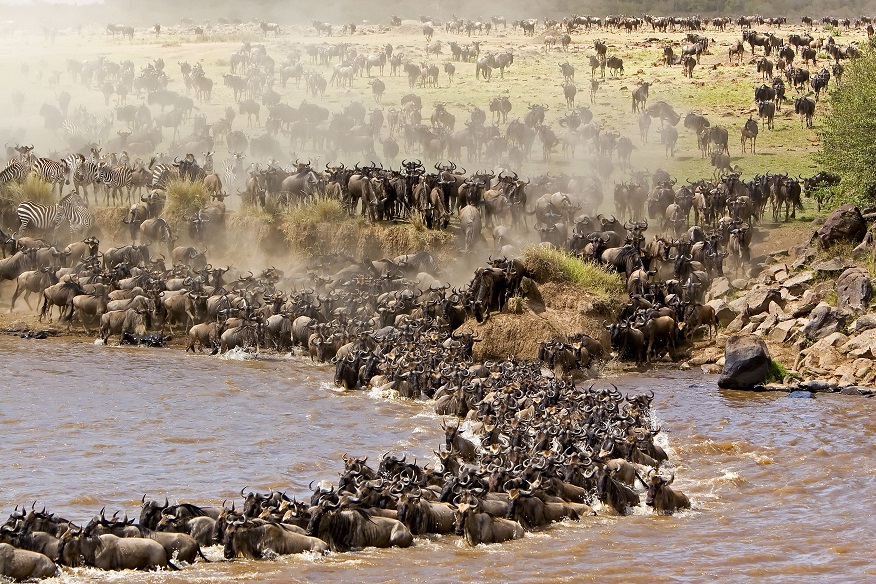
Between the end of July and November, over one-and-a-half million blue wildebeest (Connochaetes taurinus), accompanied by half again as many zebras and gazelles, migrate from the short-grass plains of Tanzania’s Serengeti National Park to fresh pasture in the grasslands of Kenya’s Masai Mara National Reserve.
Moving in groups of up to 20,000 at a time they thunder across the plateau hesitating only briefly to cross the Mara River, where many fall prey to the waiting crocodiles.
Towards the end of October, they begin crossing back into Tanzania. The actual timing of the migration, however, is dictated by the weather and does not always run to schedule.
As well as featuring in the main migration, Kenya has its own private migration, known as the Loita migration, which commences in April when some 30,000 wildebeest migrate from the conservancies to the north of the Masai Mara National Reserve to the mineral-rich soils of the Loita Plains – lingering until June when they move back to the private conservancies.
Catching up with the wildebeest migration in Kenya
Awesome is an over-used word. In relation to the annual migration of the wildebeest, however, AWESOME is the perfect word to use. Around one million wildebeest careering across the savannah-like so many manic blue-black rocking horses is a sight to be seen.
So are the accompanying herds of zebra, which seem to run with the wildebeest out of the sheer joy of living. And then there are the prowling packs of predators growing fat on the carnage.
And the massive crocodiles that leap out of the churning waters of the Mara River to snap their fearsome jaws around the oddly fragile legs of the wildebeest.
It’s quite a show: ‘The Greatest Wildlife Show on Earth’ or the ‘Seventh Natural Wonder of the world’ – you choose your title. Until you see the migration for yourself, however, you can have no comprehension of its awe-inspiring splendour. So.
How best to see wildebeest Migration?
Well, planning helps. But, the migration is a phenomenon of nature and it doesn’t run to schedule. Nor can seats be booked. But it does follow a pattern; and here’s what you need to know.
When and where to see wildebeest migration?
- December to June – The wildebeest are in the Serengeti National Reserve in Tanzania.
- July – The migration is on the move from the Serengeti to the Masai Mara National Reserve of Kenya.
- August to October – The migration is in the Masai Mara.
- November – The migration moves from the Mara to the Serengeti
What and why the wildebeest Migration?
Over one million wildebeest and several thousand zebra make a round trip of around 1,000 kilometres, over two countries (Tanzania and Kenya) in search of water and good grazing grass.
250,000 animals perish on the way. Some scientists believe that the wildebeest are motivated by the chemistry of the grass in so much as the herds are attracted to higher levels of phosphorus and nitrogen, which changes in response to the rains.
Nor is the migration one single big herd, but many smaller herds – sometimes compact, sometimes scattered. And to complicate matters further – the Mara has its own sedentary herds of wildebeest, some of which migrate within the Mara itself as part of the increasingly famous Loita Migration.
So whenever you visit Kenya, you’ll see the wildebeest – you might catch them during the birthing period, you might catch them on the move. Or you might catch them as they cross the Mara River sometime between August and October. But whenever you see them, and wherever you see them, it will be worth it.