
Ruma National Park is a wildlife refuge in western Kenya that is best known for its rolling escarpments, cliffs, and grasslands. It is also home to many species of animals and birds, including the endangered roan antelope.
A Guide To Ruma National Park
The 120sq km Ruma National Park is close to the shores of Africa’s largest inland lake, Lake Victoria. It is situated in Lambwe Valley in South Nyanza, 425km from Nairobi, 140km from Kisumu, 10km east of Lake Victoria, and southwest of Homa Bay. It also lies on the flat floor of the Lambwe Valley, bordered by the Kanyamwa escarpment to the southeast, Gwassi Hills, Sumba Hill, and Ruri Hils to the north.
Initially, the Park was founded as the Lambwe Valley Game Reserve in 1966 to protect an indigenous population of rare Roan antelope, which is found nowhere else in Kenya. In 1983 it was gazetted as a national park. It was renamed ‘Ruma’ upon the request of the local community. The area had been so named by one of Kenya’s most powerful wizards, the much-feared Gor Mahia, who lived near the park.
Quick Facts About Ruma National Park
Here is a List of Facts About Ruma National Park
- Area: 120 Square Kilometers
- Open: 6.00 am to 7.00 pm daily
- Birds: More than 400 recorded species
- Location: Suba District,Nyanza Province
- Altitude: 1,200- 1,600 meters above sea level
- Animals: Giraffe, Hyena, Impala and Velvet
- It is the last retreat of the Roan Antelope
- Vegetation: Savanna grassland and woodland with extensive acacia thickets
- Roads: 4 DW is recommended all year round and essential in the rainy seasons
- Note: No entry is allowed on foot and visitors are not allowed entry after 6.15 pm
- Climate: Humid climate, long rains falling April – June.
About Ruma National Park
Ruma National Park lies in Western Kenya, near the shores of Lake Victoria. The Park is located in one of the most productive and populous regions in Kenya and is one of the country’s more rewarding but less famous Parks.
The Park promises undiscovered wildlife treasures and an undisturbed peace mosaic of landscapes, ranging from riverine woodland and rolling savannah to magnificent escarpments and towering cliffs. It is also Kenya’s last remaining sanctuary for the endangered roan antelope.
Ruma also lies on the flat floor of the seasonally watered Lambwe River Valley. Bordered by the Kanyamwa Escarpment to the South-East, and by the Volcanic plugs of the Ruri Hills, to the North, the Park is a long, narrow corridor of land held on a fist-shaped peninsular stretching into Lake Victoria. The soils are largely “black cotton” clay (Oxisols).
History of Ruma National Park
Ruma National Park was founded in 1966 as Lambwe Valley Game Reserve. Later, it was renamed “Ruma” after one of Kenya’s most powerful wizards, the much-feared Gor Mahia who lived around the park (affiliated with Gor Mahia F.C.). The park is also located in the vast Lambwe Valley.
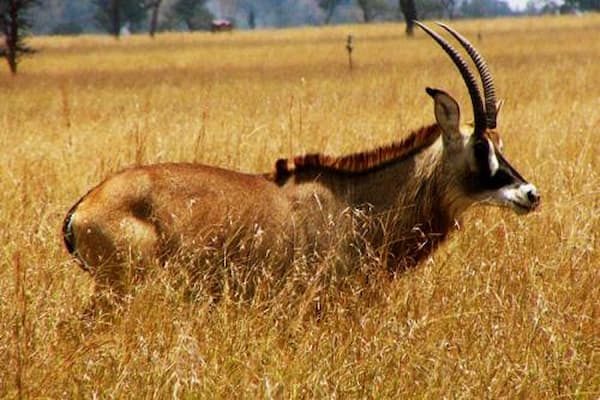
Majorly, the park was established to protect the indigenous species of rare roan antelopes known as “korongo” in Swahili which lived and are still located in the park.
What To See At Ruma National Park
Rare Wildlife
- The park offers visitors a chance to see different wildlife species including the serval cat, leopards, buffaloes, hyena, impala, baboons, vervet monkeys, oribis, roan antelope, oribi, bohor reedbuck, leopard, buffalo, Rothschild’s giraffe, and Jackson’s hartebeest.
Birdwatching Destinations
- The Park is one of the best birdwatching destinations in Kenya. It is home to over 400 bird species, making it a paradise for birdwatchers.
- The Park has over 400 species. They include rare blue swallows, sunbirds and African fish eagles, red-necked francolin, crested francolin, speckled pigeons, kingfishers, and African green- -pigeons.
Scenic Landscapes
- The Park promises undiscovered wildlife treasures and an undisturbed peace mosaic of landscapes, ranging from riverine woodland and rolling savannah to magnificent escarpments and towering cliffs.
- It is also Kenya’s last remaining sanctuary for the endangered roan antelope.
Cultural Attractions
- This includes a visit to the Luo homesteads and other tribes living near Ruma including Abasuba and the Kiisi communities. They are known for having a rich culture despite the influence of modernity. The majority practice fishing and farming.
Atrractions at Ruma National Park
The Last Refuge of the Roan Antelope
- One of Africa’s rarest antelopes and the third largest of Kenya’s antelopes, the roan (or Korongo as it is known in Swahili) is a large, grey to rufous antelope with a distinctive black and white face, not unlike a tribal mask.
- Roans live in herds of up to 20 members, led by a bull.
The Oribi Antelope
- The small and graceful oribi antelope (known as Taya in Swahili) has a conspicuous bare black glandular patch below the ears, a short black-tipped tail, and black knee tufts.
- Living in strongly bonded pairs or small groups, oribi inhabit grassland and dense undergrowth.
Accommodation and Hotels in Ruma National Park
KWS Self Catering
Campsites
The Park Picnic site
- Korlang’o picnic site which is a historical site as Korlango was used as an escape route by the Kalenjin during the colonial time when they were brought to Lambwe Valley to die during the resistance, as the place was occupied due to malaria and tsetse fly.
- Twiga picnic site which is in the middle of the Park lets you snack with the animal
How to get to Ruma National Park
- By road: The main gate is 42km from Homa Bay. From Homa Bay take the main C20 tarmac road in the direction of Rongo. After 10km branch off to the right at Rodi Kopany and proceed 20km to Mirogi.
- Also, at Mirogi follow the signs to the Park, joining at Kamato Main gate, a distance of 12km on a Murram road from Mirogi
Ruma National Park fees
Citizen
- Adults KSH: 350
- Child KSH: 200
Resident
- Adults KSH: 600
- Child KSH: 350
Non-Resident
- Adults USD:25
- Child USD:15
Ruma National Park Contacts
- Attraction Type: Wildlife
- Category: National Park, Birding Site
- Region: Western
- City / Town: Homabay
- Road / Street: Homa Bay Road
- Telephone: 254 20 352 9119, 254 721 762255
- Email: rumastn@kws.go.ke
- Website: http://www.kws.org/parks/parks_reserves/RUNP.html
- Entrance Fee: Yes
Ruma National Park is in which County?
Ruma National Park is located in Homa Bay County and occupies an area of 120km².